
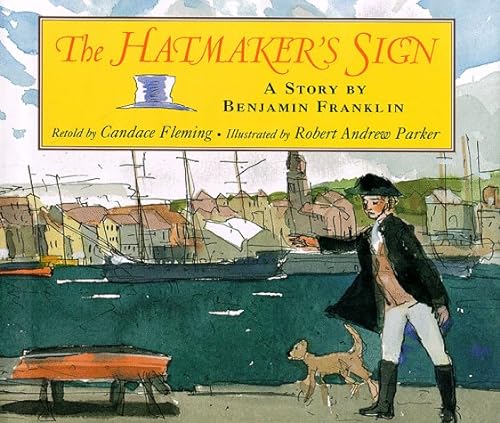
The Hatmaker's Sign: A Story
Candace Fleming; Benjamin Franklin
ISBN 10: 0531300757 ISBN 13: 9780531300756
Published by Orchard Books, 1998
Used
Hardcover
From
ThriftBooks-Reno, Reno, NV, U.S.A.
Seller rating 5 out of 5 stars

AbeBooks Seller since May 25, 2012
This specific item is no longer available.
About this Item
Description:
Former library book; Readable copy. Pages may have considerable notes/highlighting. ~ ThriftBooks: Read More, Spend Less. Seller Inventory # G0531300757I5N10
Synopsis:
When the Continental Congress quibbles about Thomas Jefferson's wording of the Declaration of Independence, Benjamin Franklin encourages his friend with a story about a hatmaker who tries to compose the perfect sign for his shop.
Reviews:
Grade 1-5?This delightful tale will be a boon to classrooms studying Colonial America and the emergence of the United States government, but it has a much broader audience as well. Culled from The Papers of Thomas Jefferson, it's a masterful retelling of a parable Benjamin Franklin whispered to calm Jefferson's anxiety during the debates over the Declaration of Independence. The story relates the plight of a Boston hatmaker trying to create a sign for his new shop. The original draft consists of 10 words and a picture of a hat. The hatmaker's wife suggests the removal of three words. Then the reverend reads it and suggests that three more words be eliminated, and so on, until the hatmaker is left with just the graphic image. More well-wishers suggest the addition of a word or two until the merchant's original draft is restored. This humorous tale ends with Franklin assuring Jefferson that anything offered to the public is subject to criticism. More importantly, the parable provides insight into how documents are changed by the input of various opinions. An author's note gives more information on Franklin's love of storytelling and Jefferson's distress over the 87 changes the Continental Congress made to the Declaration of Independence. Parker's full and often double-page watercolor illustrations capture the ambiance of colonial Boston, the annoyed Jefferson, and the soothing Franklin. They are sophisticated enough for older children, yet have plenty of appeal for younger ones, too.?Jackie Hechtkopf, Talent House School, Fairfax, VA
Copyright 1998 Reed Business Information, Inc.
Fleming (Gabriella's Song) offers a piquant retelling of a story that master raconteur Benjamin Franklin relayed "to heal the hurt pride" of Thomas Jefferson, whose draft of the Declaration of Independence was being picked apart by the quibbling Continental Congress. In this tale within a tale, a hatmaker drafts copy for a sign for his shop. En route to the sign maker, however, he encounters a string of opinionated people who whittle away his words to, quite literally, nothing. Young readers will easily appreciate the irony of the kind sign maker's suggestion that the hatmaker fill his sign with the very proclamation he began with. Franklin concludes, "No matter what you write, or how well you write it, if the public is going to read it, you can be sure they will want to change it." Working in ink and watercolor, Parker (Pop Corn and Ma Goodness) contributes his sketchy style, a deft approach that focuses on Franklin's wit rather than his more serious message. And like the beleaguered hatmaker, Fleming has chosen her words with care, delivering an insightful parable and a welcome addition to the wealth of lore surrounding the remarkable Benjamin Franklin. Endnotes include further information about Franklin, Jefferson and the writing of the Declaration of Independence; like the story, they will whet readers' appetites for American history. Ages 5-9.
Copyright 1998 Reed Business Information, Inc.
0-531-33075-3 Thomas Jefferson was feeling stung. The Continental Congress was demanding that he rewrite sections of his Declaration of Independence. Replace this, cut that, the delegates urged. Smoldering, Jefferson took a seat: ``I thought my words were perfect just the way they were,'' he muttered. Hoping to soothe his friend, Ben Franklin quietly told him the parable of the hatmaker, who had designed a sign for his shop: ``John Thompson, Hatmaker, Fashionable Hats Sold Inside for Ready Money.'' After his wife, Hannah, suggests one phrase be deleted, Thompson shows his revised design to others, each of whom has another cut to suggest. Thompson appears at the signmaker's shop with a blank piece of paper. Puzzled, the signmaker suggests: ``John Thompson, Hatmaker, Fashionable Hats Sold Inside for Ready Money.'' ``So you see, Tom,'' concluded Ben. ``No matter what you write, or how well you write it, if the public is going to read it, you can be sure they will want to change it.'' Grander than the story itself is its basis in real events, and Fleming (Gabriella's Song, 1997, etc.) fleshes out the particulars in an excellent author's note. Adding considerably to the charm of the book are Parker's ink-and-watercolor illustrations, with a sketched, fleeting quality that seems to summon the events from history and renders them with immediacy. (Picture book. 5-9) -- Copyright ©1998, Kirkus Associates, LP. All rights reserved.
Gr. 3^-5, younger for reading aloud. According to the appended Author's Note, Thomas Jefferson once recalled that after writing the Declaration of Independence, "Dr. Franklin perceived that I was not insensitive to Congress' mutilation of my document and tried to reassure me by whispering a parable." That incident leads into Frank-lin's parable, which forms the main focus of this picture book for older children. A Boston hatmaker has designed a new sign for his shop, consisting of a picture of a hat and the words John Thompson. Hatmaker. Fashionable Hats Sold Inside for Ready Money. Each person he meets on his way to the signmaker's shop convinces him to remove another word or two from the sign, until nothing is left but the hat, which a Harvard professor suggests is redundant since hats are displayed in the window. Mr. Thompson finally arrives at his destination, where the signmaker suggests the same picture and text the hatmaker originally intended. Though the story within a story may be confusing for young children, this picture book will be a vivid read-aloud or read-alone choice for middle-grade children studying the Declaration of Independence. Bostonians will revel in the references to local places, both in the text and in Parker's expressive ink drawings tinted with delicate watercolor washes that make the incident come alive. Carolyn Phelan
"About this title" may belong to another edition of this title.
Bibliographic Details
Title: The Hatmaker's Sign: A Story
Publisher: Orchard Books
Publication Date: 1998
Binding: Hardcover
Illustrator: Parker, Robert Andrew
Condition: Fair
Dust Jacket Condition: No Jacket