Synopsis
“I didn’t think about the dangers before going into space, but now I realize how hazardous it is!”
–Cosmonaut Alexei Leonov, first person to walk in space
With the opening of the International Space Station at the start of this century and Richard Branson’s Virgin Galactic company planning to take people above the Earth’s atmosphere next year, widespread space travel will soon leave the realm of science fiction.
Tourist trips to the Moon, asteroids, comets, Mars, and beyond are likely to become available in the next fifty years. But space isn’t Cancún. Travelers will live life on a razor’s edge, faced with potential disasters, from the thunderous liftoff to the unpredictable volcanic eruptions on Io, Jupiter’s most spectacular moon; from the high-speed impact of pebble-sized micrometeorites to the crumbling of a comet’s surface beneath your feet.
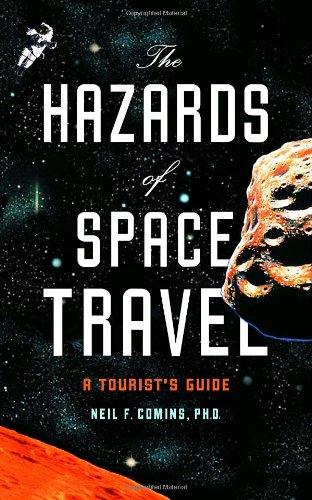
Now renowned physicist and astronomer Neil F. Comins, Ph.D., has written a hands-on guide to outer space for potential tourists and armchair travelers. Bringing to life the hard science are the fictional log entries of an imaginary colleague from the future, astronaut Mack Richardson. Together they reveal the risks and challenges that await tourists in the days they would spend orbiting the Earth, the weeks required for a trip to the Moon, and the years needed to go anywhere else in the solar system. Space is the new frontier of extreme adventuring, and The Hazards of Space Travel is a fun, fascinating, and informative guide to your own imminent space odyssey when the sky’s no longer the limit.
Reviews
Adult/High School—Comins predicts that space tourism as far afield as the Jovian system may be feasible by the end of this century. This book, however, is less a sightseer's travel guide to our solar system than a description of the myriad hazards and unresolved problems facing humans traveling in interplanetary space. Landslides on Mars, volcanic eruptions on Io, quakes on Europa, galactic cosmic rays, meteoroids, a lack of water, fragile bones, genetic mutation, motion sickness, computer hackers-all these dangers and more await them. The author clearly presents basic information on the source of the danger, its effects on travelers, and the difficulties involved in protecting against it. The text is supplemented by fictitious entries from a space traveler's diary that illustrate how particular hazards might be addressed, as well as by clear black-and-white photographs and diagrams and an extensive bibliography. Future scientists will find this book thought-provoking, and SF fans can also enjoy it.—Sandy Schmitz, Berkeley Public Library, CA
Copyright © Reed Business Information, a division of Reed Elsevier Inc. All rights reserved.
Looking to the future of space tourism, which will include vacation packages to the Moon, Mars, and Jovian moons, physicist Comins relates the risks holidaymakers will be running. Some, such as equipment failure and physiological damage like muscular atrophy, are dangers already experienced in spaceflight. Landslides and volcanic eruptions, however, are the death dealers the extreme traveler will confront. Via the fictional device of a future voyager's log, Comins, in the course of categorizing hazards, imagines a range of crises faced by passengers and crew. An unremitting threat comes from dust and radiation, while an intermittent menace is a hyperkinetic rock. If mechanical failures or natural disasters don't provoke sufficient dread, the tourist can fret about the small percentage of mates who will mentally break down on the trip. Direct and sober on the science, Comins is fascinating on the morbid facts. Sure to enthrall space futurists. Gilbert Taylor
Copyright © American Library Association. All rights reserved
"About this title" may belong to another edition of this title.