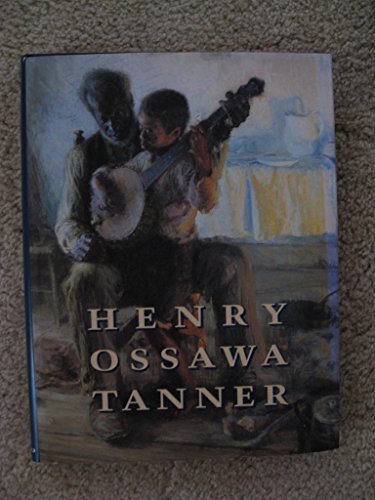
Synopsis
Recounts the life of the Black expatriate artist and the critical reception of his work
Reviews
The reputation of an important, unjustly neglected American artist is restored in this lavish catalogue of a touring exhibition assembled by Sewell, a curator at the Philadelphia Museum of Art; Mosby, director of the Picker Art Gallery at Colgate University; and Alexander-Minter, of the New-York Historical Society. Son of an African Methodist Episcopal minister, Henry Tanner (1859-1937) trained under Thomas Eakins in Philadelphia, then left his native U.S. in 1891 for Paris; a proud, quiet individualist determined to surmount racism, he would spent most of his life in France, serving as a beacon to the Harlem Renaissance. Tanner's sensitive, naturalistic animal studies, modernized reinterpretations of biblical themes, subdued yet powerful WW I scenes and brooding, mystical oriental pictures had an impact that was "by no means race-bound"; his continual experimentation with techniques likewise influenced many artists. Tanner's marvelous visionary paintings of the late 1920s and early '30s are full of foreboding of a world on the brink of self-destruction.
Copyright 1991 Reed Business Information, Inc.
Scion of a distinguished African American family, Tanner achieved international fame as a painter of genre and religious scenes in the first decades of this century only to lapse into obscurity in self-imposed exile in France. His resurrection and reappraisal, begun in the 1960s, will be greatly aided by this well-illustrated and scholarly catalog of the current nationally traveling retrospective. By virtue of its integration of biography and art criticism with 105 color and 94 black-and-white illustrations, this book is the preeminent work on Tanner. Recommended for art, academic, and public libraries.
- David McClelland, Temple Univ. Lib., Philadelphia
Copyright 1991 Reed Business Information, Inc.
"About this title" may belong to another edition of this title.