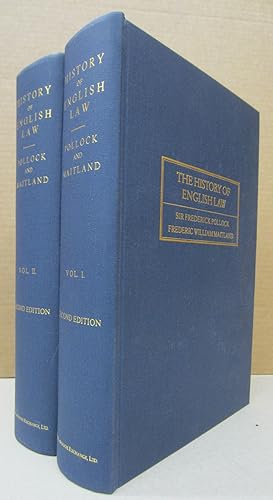
Reprint of the second and best edition. The History of English Law was the first systematic history based on modern historical methods. It addresses the period before the Norman Conquest in 1066, but deals primarily with the creation and establishment of the common law, a process initiated in the reign of Henry II (1154-1189) and concluded in the reign of Edward I (1272-1307). The first volume traces this history. The second volume treats the doctrines of the common law, including tenure, the law of personal condition, status and estate, and the jurisdiction and communities of the land. Gracefully written and enriched with countless references this is an essential book. First published in 1895, it remains a primary text for students of legal history and the social history of medieval England. "[Its] interpretation of the making of the common law made all previous accounts completely obsolete and was unchallenged until the 1960s. (...) It is an astonishing achievement, one of the truly great pieces of historical literature of all time, these chapters by Pollock and Maitland.": Norman F. Cantor, Inventing the Middle Ages 58, 66.
Sir Frederick Pollock [1845-1937] was an English jurist best known for this work as well as his extensive correspondence with US Supreme Court Justice Oliver Wendell Holmes, which was published posthumously as The Holmes-Pollock Letters. His treatises on contracts, jurisprudence the common law and other subjects did much to clarify and systematize English law. Several of these were standard texts that went through several editions. He was educated at Trinity College, Cambridge, and admitted to the Bar in 1871. He taught at the University of Oxford from 1883-1903. Widely considered the father of legal history, Frederic William Maitland [1850-1906] was an English jurist and historian best known for this standard work. He was educated at Eton and Cambridge and studied at Lincoln.
Sir Frederick Pollock [1845-1937] was an English jurist best known for this work as well as his extensive correspondence with US Supreme Court Justice Oliver Wendell Holmes, which was published posthumously as The Holmes-Pollock Letters. His treatises on contracts, jurisprudence the common law and other subjects did much to clarify and systematize English law. Several of these were standard texts that went through several editions. He was educated at Trinity College, Cambridge, and admitted to the Bar in 1871. He taught at the University of Oxford from 1883-1903.
Widely considered the father of legal history, Frederic William Maitland [1850-1906] was an English jurist and historian best known for this standard work. He was educated at Eton and Cambridge and studied at Lincoln's Inn, London. Maitland was called to the bar in 1876, and practiced until 1884 when he became a reader in English law (1884) and professor (1888) at Cambridge. He founded the Selden Society in 1887. Hailed for his original outlook on history, his works profoundly influenced legal scholarship. An extraordinarily productive career was shortened by his death from pneumonia at the age of 56.