About this Item
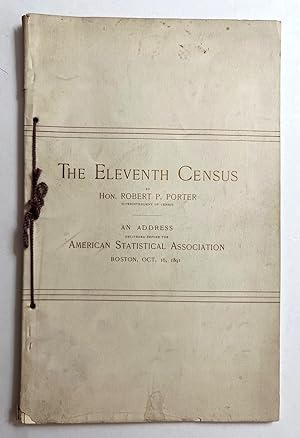
(Hollerith) Porter, Robert P. (Superintendent of Census). An Address Delivered before the American Statistical Association, Boston, Oct. 16, 1891. New York Engraving and Printing Company, 1891. 9"x 5.5", 64pp. Original wrappers, flat-backed spine, tie binding. Provenance: U.S. Geological Survey to the Library of Congress (1931). VG condition. ("10mm perforated "LC" on title bottom and US geological stamp on the reverse of the title.) Aside from the general business and performance of conducting the census, the piece of essential interest here is Porter's discussion of the new method of tabulation this of course is the revolutionary card tabulator system of Herman Hollerith (though his name is mentioned only twice)--and the differences between the new and old methods of calculation at the Census Office. The discussion ranges from pp 17-24, with the most interesting quotes on the machine and process coming from "Mr. Wines" (Frederick Howard Wines, who wrote the 400-page "Report On Crime Pauperism And Benevolence" in 1896 as part of the 1890 Census): "The essential difference between the Eleventh Census and that which preceded it was the adoption of the card system for the tallying of results and the use of the newly invented Hollerith electrical machine for counting the cards. Too much can scarcely be said in praise of this machine, which has enabled us to compute results with much greater rapidity than the old method of tallying." (pp 12-20). ALSO: "The first advantage of the Hollerith system is the more than stenographic celerity with which the record of each individual enumerated is transferred from the original schedule to the cards for tallying. Instead of the multiplied motions required in transcription by the ordinary process of writing, one turn of the wrist suffices for the recording of each reported fact. If some time is lost in placing the cards in position in the punching machine, on the other hand the record does not require so many independent physical movements as are necessary even in stenographic writing, where each line represents a sound." AND also: "After this, the 63,000,000 cards with their thousand million statements must each pass through the tabulating machine five times." pg 18. Tabulating cards are also discussed on pp 4, 11, 12, 14, 17-22. There was a lot more discussion and explanation of the tabulating system than I expected in this short work.
Seller Inventory # ABE-1710690158923
Contact seller
Report this item