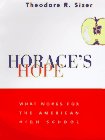
Synopsis
A third book in an influential trilogy concerned with educational change by a respected educator offers a comprehensive model for desperately needed reform in America's secondary schools, envisioning the educational system of the future and giving cause for optimism.
Reviews
Sizer (Horace's Compromise and Horace's School), director of the Annenberg Institute for School Reform, in this third volume of his trilogy takes an informed look at the state of secondary education and offers his dreams for the future. "Horace," who represents a composite of the dedicated but frustrated teachers Sizer encountered in his visits to high schools across the country, still has a commitment to education, although he is being forced to make compromises at the expense of the students he teaches. To change high schools into viable learning institutions for all, the author advocates an end to administrative bureaucracy and real empowerment for teachers, a choice of specialized schools for families from all income levels, state rather than local school financing and the adaptation of emerging technology to reinforce learning at home, in the neighborhood or in a cultural or workplace environment. This is a heartfelt plea for high-school reform by an educator who cares deeply about young people.
Copyright 1996 Reed Business Information, Inc.
The third in a series about changing America's schools, from the noted educator who launched a successful if snail's-pace revolution that both demands more and elicits more from adolescent students. A decade ago, Sizer (Horace's School, 1992) participated in a study of American high schools that found an educational assembly line offering rote skills and a frozen curriculum left over from the turn of the century. But in today's world, where the media, not the academies, set the ``common vocabulary,'' Sizer believes that schools must give children the tools to understand and if necessary challenge their often profit-driven ideas. ``Informed skepticism'' is the goal, he believes. It can be achieved through small classes and multidisciplinary, project- oriented goals that are assessed by ``exhibitions'' (echoing dissertation defenses) rather than standardized exams. This orientation, with its emphasis on curricula driven by teachers and parents, makes a strong case for school choice. Virtually buried in the text is a modest solution to the problem of bad schools in bad neighborhoods. Sizer suggests that geographic boundaries be obliterated, with public money following the student to the school of choice. A family in a poor section of the Bronx could opt for a school in nearby, affluent Westchester County, for instance, and enrollment would be determined by lottery. Surely, Westchester parents whose children were not lottery winners would bring political pressure for quality schools in the Bronx. Except for the lottery, Sizer's earlier books set forth most of the ideas found here, and despite the book's title, the fictional teacher ``Horace'' is not much in evidence. This is instead a celebration of the successes of Sizer's Coalition of Essential Schools, which supports the growing number of schools embracing the group's goals. Disarming in the defense of a new schoolroom for the 21st century, Sizer himself illustrates education at its best, setting up arguments, marshalling evidence, and reaching a convincing conclusion. (Author tour) -- Copyright ©1996, Kirkus Associates, LP. All rights reserved.
This lucid, accessible, and cogently argued assessment of the American educational reform movement at the high school level caps Sizer's Horace's Compromise (LJ 2/15/84) and Horace's School (LJ 1/92). Sizer, who founded the Coalition of Essential Schools in 1984 to promote school reforms, here outlines how the coalition's reforms have been adopted, how well they are working, and how much further the educational establishment has to change. He again stresses knowing each student well, minimizing testing, promoting exhibitions and portfolios as assessment devices, among other recommendations. Horace Smith, his fictionalized "everyteacher," hopes that schools are changing for the better in providing access to the American culture and ways to enrich it. The insights of this important reformer should be available in all libraries serving education students, teachers, school administators, and concerned parents.
-?Scott R. Johnson, Meridian Community Coll. Lib., Miss.
Copyright 1996 Reed Business Information, Inc.
"About this title" may belong to another edition of this title.