
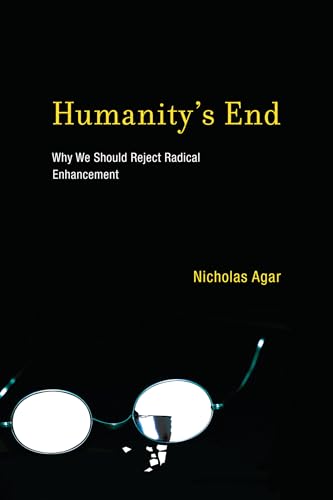
Humanity's End: Why We Should Reject Radical Enhancement (Life and Mind: Philosophical Issues in Biology and Psychology)
Agar, Nicholas
ISBN 10: 0262525178 ISBN 13: 9780262525176
Published by MIT Press, 2013
Used
paperback
From
HPB Inc., Dallas, TX, U.S.A.
Seller rating 5 out of 5 stars

AbeBooks Seller since September 15, 2017
This specific item is no longer available.
About this Item
Description:
Connecting readers with great books since 1972! Used books may not include companion materials, and may have some shelf wear or limited writing. We ship orders daily and Customer Service is our top priority! Seller Inventory # S_454069286
Synopsis:
An argument that achieving millennial life spans or monumental intellects will destroy values that give meaning to human lives.
Proposals to make us smarter than the greatest geniuses or to add thousands of years to our life spans seem fit only for the spam folder or trash can. And yet this is what contemporary advocates of radical enhancement offer in all seriousness. They present a variety of technologies and therapies that will expand our capacities far beyond what is currently possible for human beings. In Humanity's End, Nicholas Agar argues against radical enhancement, describing its destructive consequences.
Agar examines the proposals of four prominent radical enhancers: Ray Kurzweil, who argues that technology will enable our escape from human biology; Aubrey de Grey, who calls for anti-aging therapies that will achieve “longevity escape velocity”; Nick Bostrom, who defends the morality and rationality of enhancement; and James Hughes, who envisions a harmonious democracy of the enhanced and the unenhanced. Agar argues that the outcomes of radical enhancement could be darker than the rosy futures described by these thinkers. The most dramatic means of enhancing our cognitive powers could in fact kill us; the radical extension of our life span could eliminate experiences of great value from our lives; and a situation in which some humans are radically enhanced and others are not could lead to tyranny of posthumans over humans.
About the Author: Nicholas Agar is Professor of Ethics at Victoria University of Wellington, New Zealand. He is the author of Humanity's End: Why We Should Reject Radical Enhancement and Truly Human Enhancement: A Philosophical Defense of Limits, both published by the MIT Press.
"About this title" may belong to another edition of this title.
Bibliographic Details
Title: Humanity's End: Why We Should Reject Radical...
Publisher: MIT Press
Publication Date: 2013
Binding: paperback
Condition: Very Good