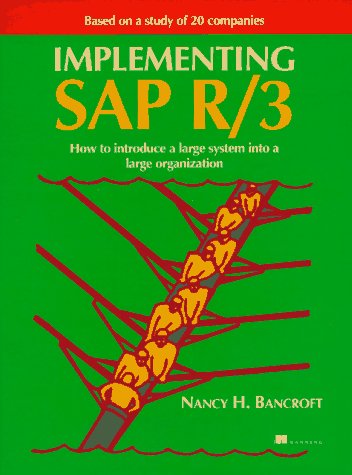
This text provides information on SAP implementation derived from a research study of 20 companies that have implemented R/3. Over 50 people were interviewed, including executives, project managers, change management specialists, consultants in the Big 6, and SAP employees.
Frankness is a quality permeating the pages of
Implementing SAP R/3: How to Introduce a Large System into a Large Organization. Mining nearly three decades worth of combined consulting experience, authors Bancroft, Seip, and Sprengel provide incisive and brutally honest insight into what it means to overhaul both business and computing practices with SAP R/3. The book focuses more on business and process reengineering than configurations or programming.
Implementing SAP R/3 does manage to provide a balanced view of the technological components of the R/3 system. The authors take pains to explain what types of businesses it is best suited for, its failures and shortcomings, as well as its triumphs.
The explanation of R/3 that kick starts this book is highly approachable, detailing the philosophical and technical underpinnings of this system. The other three loosely constructed sections deal almost exclusively with the complexity of an R/3 implementation. Throughout these portions, the authors emphasize the importance of identifying and establishing project goals, a point liberally illustrated by various case studies. Additionally, a terrific glossary is tucked away in the final pages, as are four appendices. These appendices cover data-modeling and relational-database concepts, content and structure of the SAP data dictionary, and the development of Advanced Business Application Programming/4GL (ABAP4). --Sarah L. Roberts-Witt