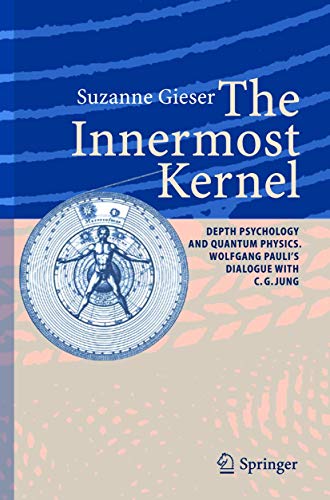
"The Innermost Kernel" offers an insightful examination of the research and history of the physicist and Nobel Laureate Wolfgang Pauli and his interest in Jungian psychology, philosophy and western world-view. It is also a study of the intellectual setting and context of Pauli's thinking, i.e. a contribution to the general history of quantum physics, especially concerning the relation of the new physics to psychology. The focus highlights psychological, philosophical and ontological issues and ultimately the possibility of a new understanding of the interrelatedness of man and world. The work is primarily based on the correspondence of the principle characters, and the terminology is mostly from philosophy, Jungian psychology and, a minor part, from physics/mathematics. The author seeks to enhance our understanding of the history of quantum physics and to offer original insight into the fascinating thoughts of Wolfgang Pauli.
"The Innermost Kernel" recounts the physicist and Nobel Laureate Wolfgang Pauli and his interest in Jungian psychology, philosophy and western world-view. It is also an exploration of the intellectual setting and context of Pauli's thinking, which has its starting point in the cultural and intellectual climate of fin-de-siècle Europe. As a contribution to the general history of quantum physics this study has a special focus on the psychological and philosophical issues discussed by physicists belonging to the Copenhagen school. The work is mainly based on the correspondence of the principle characters and explores some of the central issues discussed there, as for instance the subject-object relation, complementarity, the relation of conscious and unconscious, the process underlying concept-formation, the psychology of scientific discovery, the symbolic world of alchemy, the theories of archetypes and of synchronicity. Ultimately this book is about a remarkable scientist searching for a new understanding of the interrelatedness of man and world.