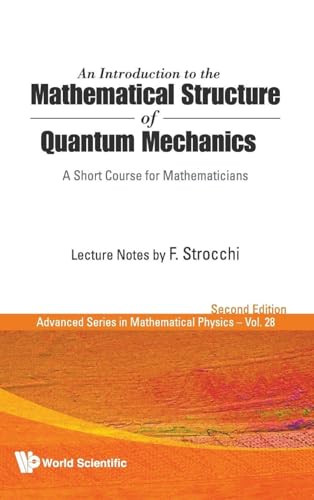
Introduction To The Mathematical Structure Of Quantum Mechanics, An: A Short Course For Mathematicians (2nd Edition)
Strocchi Franco
ISBN 10: 9812835229 ISBN 13: 9789812835222
Published by World Scientific Publishing Company, 2008
New
HRD
From
PBShop.store US, Wood Dale, IL, U.S.A.
Seller rating 5 out of 5 stars

AbeBooks Seller since April 7, 2005
This specific item is no longer available.
About this Item
Description:
New Book. Shipped from UK. Established seller since 2000. Seller Inventory # CW-9789812835222
Synopsis:
The second printing contains a critical discussion of Dirac derivation of canonical quantization, which is instead deduced from general geometric structures. This book arises out of the need for Quantum Mechanics (QM) to be part of the common education of mathematics students. The mathematical structure of QM is formulated in terms of the C*-algebra of observables, which is argued on the basis of the operational definition of measurements and the duality between states and observables, for a general physical system.The Dirac-von Neumann axioms are then derived. The description of states and observables as Hilbert space vectors and operators follows from the GNS and Gelfand-Naimark Theorems. The experimental existence of complementary observables for atomic systems is shown to imply the noncommutativity of the observable algebra, the distinctive feature of QM; for finite degrees of freedom, the Weyl algebra codifies the experimental complementarity of position and momentum (Heisenberg commutation relations) and Schrödinger QM follows from the von Neumann uniqueness theorem.The existence problem of the dynamics is related to the self-adjointness of the Hamiltonian and solved by the Kato-Rellich conditions on the potential, which also guarantee quantum stability for classically unbounded-below Hamiltonians. Examples are discussed which include the explanation of the discreteness of the atomic spectra.Because of the increasing interest in the relation between QM and stochastic processes, a final chapter is devoted to the functional integral approach (Feynman-Kac formula), to the formulation in terms of ground state correlations (the quantum mechanical analog of the Wightman functions) and their analytic continuation to imaginary time (Euclidean QM). The quantum particle on a circle is discussed in detail, as an example of the interplay between topology and functional integral, leading to the emergence of superselection rules and θ sectors.
Review:
... looks like a 'tour de force', being able to cover such a large amount of difficult material in 140 pages, in a perfectly clear way. -- Jean-Pierre Antoine, Université catholique de Louvain, Belgium
... written in a very clear and compact style ... provides a unified and physically motivated presentation of different mathematical topics. -- Zentralblatt MATH
A very useful tool for mathematicians to enter the not so mysterious framework of quantum theory for finite degrees of freedom. -- Professor Grosse Harald, University of Vienna, Austria
"About this title" may belong to another edition of this title.
Bibliographic Details
Title: Introduction To The Mathematical Structure ...
Publisher: World Scientific Publishing Company
Publication Date: 2008
Binding: HRD
Condition: New
Edition: 2nd Edition
Top Search Results from the AbeBooks Marketplace

Stock Image
INTRODUCTION TO THE MATHEMATICAL STRUCTURE OF QUANTUM MECHANICS, AN: A SHORT COURSE FOR MATHEMATICIANS (2ND EDITION) (Advanced Mathematical Physics)
Published by
World Scientific Publishing Company, 2008
ISBN 10: 9812835229
ISBN 13: 9789812835222
Used
Hardcover
Seller: MostlyAcademic, Berrima, NSW, Australia
Seller rating 5 out of 5 stars
Hardcover. Condition: As New. 2nd Edition. Seller Inventory # ABE-1756697679367
Buy Used
US$ 27.25
US$ 34.95 shipping
Ships from Australia to U.S.A.
Ships from Australia to U.S.A.
Quantity: 1 available
Stock Image
An Introduction to the Mathematical Structure of Quantum Mechanics : A Short Course for Mathematicians
Published by
World Scientific Publishing Co Pte Ltd, 2008
ISBN 10: 9812835229
ISBN 13: 9789812835222
Used
Hardcover
Seller: Better World Books, Mishawaka, IN, U.S.A.
Seller rating 5 out of 5 stars
Condition: Very Good. Former library book; may include library markings. Used book that is in excellent condition. May show signs of wear or have minor defects. Seller Inventory # 52849270-6
Stock Image
INTRODUCTION TO THE MATHEMATICAL STRUCTURE OF QUANTUM MECHANICS, AN: A SHORT COURSE FOR MATHEMATICIANS (2ND EDITION) (Advanced Mathematical Physics)
Published by
World Scientific Publishing Company, 2008
ISBN 10: 9812835229
ISBN 13: 9789812835222
New
Hardcover
Seller: Lucky's Textbooks, Dallas, TX, U.S.A.
Seller rating 5 out of 5 stars
Condition: New. Seller Inventory # ABLIING23Apr0412070095053
Seller Image
Introduction To The Mathematical Structure Of Quantum Mechanics, An: A Short Course For Mathematicians (2nd Edition)
Published by
World Scientific Publishing Co Pte Ltd, SG, 2008
ISBN 10: 9812835229
ISBN 13: 9789812835222
New
Hardcover
Seller: Rarewaves.com USA, London, LONDO, United Kingdom
Seller rating 5 out of 5 stars
Hardback. Condition: New. The second printing contains a critical discussion of Dirac derivation of canonical quantization, which is instead deduced from general geometric structures. This book arises out of the need for Quantum Mechanics (QM) to be part of the common education of mathematics students. The mathematical structure of QM is formulated in terms of the C*-algebra of observables, which is argued on the basis of the operational definition of measurements and the duality between states and observables, for a general physical system.The Dirac-von Neumann axioms are then derived. The description of states and observables as Hilbert space vectors and operators follows from the GNS and Gelfand-Naimark Theorems. The experimental existence of complementary observables for atomic systems is shown to imply the noncommutativity of the observable algebra, the distinctive feature of QM; for finite degrees of freedom, the Weyl algebra codifies the experimental complementarity of position and momentum (Heisenberg commutation relations) and Schrödinger QM follows from the von Neumann uniqueness theorem.The existence problem of the dynamics is related to the self-adjointness of the Hamiltonian and solved by the Kato-Rellich conditions on the potential, which also guarantee quantum stability for classically unbounded-below Hamiltonians. Examples are discussed which include the explanation of the discreteness of the atomic spectra.Because of the increasing interest in the relation between QM and stochastic processes, a final chapter is devoted to the functional integral approach (Feynman-Kac formula), to the formulation in terms of ground state correlations (the quantum mechanical analog of the Wightman functions) and their analytic continuation to imaginary time (Euclidean QM). The quantum particle on a circle is discussed in detail, as an example of the interplay between topology and functional integral, leading to the emergence of superselection rules and ? sectors. Seller Inventory # LU-9789812835222
Buy New
US$ 88.86
Free Shipping
Ships from United Kingdom to U.S.A.
Ships from United Kingdom to U.S.A.
Quantity: 12 available
Seller Image
An Introduction to the Mathematical Structure of Quantum Mechanics
Published by
World Scientific Publishing Company, 2008
ISBN 10: 9812835229
ISBN 13: 9789812835222
New
Hardcover
Seller: moluna, Greven, Germany
Seller rating 4 out of 5 stars

Gebunden. Condition: New. Dieser Artikel ist ein Print on Demand Artikel und wird nach Ihrer Bestellung fuer Sie gedruckt. InhaltsverzeichnisMathematical Description of a Physical System Mathematical Description of a Quantum System The Quantum Particle Quantum Dynamics. The Schrodinger Equation Examples Quantum Mechanics and Stochastic Processes. Seller Inventory # 449941929
Buy New
US$ 93.12
US$ 57.38 shipping
Ships from Germany to U.S.A.
Ships from Germany to U.S.A.
Quantity: Over 20 available
INTROD TO THE MATH'L STRUCTURE (2E)(V28)
Print on DemandSeller: preigu, Osnabrück, Germany
Seller rating 5 out of 5 stars
Buch. Condition: Neu. INTROD TO THE MATH'L STRUCTURE (2E)(V28) | Strocchi F | Buch | Gebunden | Englisch | 2008 | World Scientific | EAN 9789812835222 | Verantwortliche Person für die EU: Libri GmbH, Europaallee 1, 36244 Bad Hersfeld, gpsr[at]libri[dot]de | Anbieter: preigu Print on Demand. Seller Inventory # 101708745
Buy New
US$ 96.69
US$ 81.99 shipping
Ships from Germany to U.S.A.
Ships from Germany to U.S.A.
Quantity: 5 available
Seller Image
INTROD TO THE MATH'L STRUCTURE (2E)(V28)
Print on DemandSeller: AHA-BUCH GmbH, Einbeck, Germany
Seller rating 5 out of 5 stars
Buch. Condition: Neu. nach der Bestellung gedruckt Neuware - Printed after ordering - The second printing contains a critical discussion of Dirac derivation of canonical quantization, which is instead deduced from general geometric structures. This book arises out of the need for Quantum Mechanics (QM) to be part of the common education of mathematics students. The mathematical structure of QM is formulated in terms of the C\*-algebra of observables, which is argued on the basis of the operational definition of measurements and the duality between states and observables, for a general physical system.The Dirac-von Neumann axioms are then derived. The description of states and observables as Hilbert space vectors and operators follows from the GNS and Gelfand-Naimark Theorems. The experimental existence of complementary observables for atomic systems is shown to imply the noncommutativity of the observable algebra, the distinctive feature of QM; for finite degrees of freedom, the Weyl algebra codifies the experimental complementarity of position and momentum (Heisenberg commutation relations) and Schrödinger QM follows from the von Neumann uniqueness theorem. The existence problem of the dynamics is related to the self-adjointness of the Hamiltonian and solved by the Kato-Rellich conditions on the potential, which also guarantee quantum stability for classically unbounded-below Hamiltonians. Examples are discussed which include the explanation of the discreteness of the atomic spectra. Because of the increasing interest in the relation between QM and stochastic processes, a final chapter is devoted to the functional integral approach (Feynman-Kac formula), to the formulation in terms of ground state correlations (the quantum mechanical analog of the Wightman functions) and their analytic continuation to imaginary time (Euclidean QM). The quantum particle on a circle is discussed in detail, as an example of the interplay between topology and functional integral, leading to the emergence of superselection rules and ? sectors. Seller Inventory # 9789812835222
Buy New
US$ 113.48
US$ 72.85 shipping
Ships from Germany to U.S.A.
Ships from Germany to U.S.A.
Quantity: 1 available
Stock Image
An Introduction to the Mathematical Structure of Quantum Mechanics: A Short Course for Mathematicians
Published by
World Scientific Pub Co Inc, 2008
ISBN 10: 9812835229
ISBN 13: 9789812835222
New
Hardcover
Seller: Revaluation Books, Exeter, United Kingdom
Seller rating 5 out of 5 stars
Hardcover. Condition: Brand New. 2nd edition. 200 pages. 9.06x6.14x0.79 inches. In Stock. Seller Inventory # x-9812835229
Buy New
US$ 119.96
US$ 13.38 shipping
Ships from United Kingdom to U.S.A.
Ships from United Kingdom to U.S.A.
Quantity: 2 available
Seller Image
Introduction To The Mathematical Structure Of Quantum Mechanics, An: A Short Course For Mathematicians (2nd Edition)
Published by
World Scientific Publishing Co Pte Ltd, SG, 2008
ISBN 10: 9812835229
ISBN 13: 9789812835222
New
Hardcover
Seller: Rarewaves.com UK, London, United Kingdom
Seller rating 5 out of 5 stars
Hardback. Condition: New. The second printing contains a critical discussion of Dirac derivation of canonical quantization, which is instead deduced from general geometric structures. This book arises out of the need for Quantum Mechanics (QM) to be part of the common education of mathematics students. The mathematical structure of QM is formulated in terms of the C*-algebra of observables, which is argued on the basis of the operational definition of measurements and the duality between states and observables, for a general physical system.The Dirac-von Neumann axioms are then derived. The description of states and observables as Hilbert space vectors and operators follows from the GNS and Gelfand-Naimark Theorems. The experimental existence of complementary observables for atomic systems is shown to imply the noncommutativity of the observable algebra, the distinctive feature of QM; for finite degrees of freedom, the Weyl algebra codifies the experimental complementarity of position and momentum (Heisenberg commutation relations) and Schrödinger QM follows from the von Neumann uniqueness theorem.The existence problem of the dynamics is related to the self-adjointness of the Hamiltonian and solved by the Kato-Rellich conditions on the potential, which also guarantee quantum stability for classically unbounded-below Hamiltonians. Examples are discussed which include the explanation of the discreteness of the atomic spectra.Because of the increasing interest in the relation between QM and stochastic processes, a final chapter is devoted to the functional integral approach (Feynman-Kac formula), to the formulation in terms of ground state correlations (the quantum mechanical analog of the Wightman functions) and their analytic continuation to imaginary time (Euclidean QM). The quantum particle on a circle is discussed in detail, as an example of the interplay between topology and functional integral, leading to the emergence of superselection rules and ? sectors. Seller Inventory # LU-9789812835222
Buy New
US$ 126.04
US$ 86.95 shipping
Ships from United Kingdom to U.S.A.
Ships from United Kingdom to U.S.A.
Quantity: 12 available