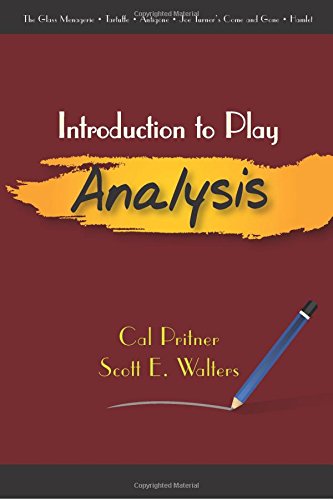
"To succeed in the theatre, students must have strong skills in analyzing plays." So states the authors' rationale for this concise text that offers a step-by-step approach to recognizing how plays work. Pritner and Walters guide the reader through four levels of reading a play. This approach progresses from a purely subjective and personal response, through objective information gathering, and on to more complex levels of interpretation.
Each chapter of Introduction to Play Analysis introduces a concept that is then explored by studying its application to The Glass Menagerie, chosen for its simultaneous accessibility and complexity. Other examples rely on works by Sophocles, Molière, August Wilson, and Shakespeare. End-of-chapter questions can be applied to any play being analyzed.
Table of Contents in Brief:
Introduction: The Why and What of Play Analysis
I: FIRST IMPRESSIONS
1. The First Reading
II: GATHERING INFORMATION
2. Given Circumstances 3. Theatrical Contract
III: INTERPRETATION
4. Character 5. Conflict 6. Conflict Analysis Applied to a Scene 7. Supplemental Research
IV: BRINGING IT TOGETHER
8. Synthesis
Appendixes: Analyzing Shakespeare's Hamlet / Character Maps / Key Terms
Cal Pritner began teaching in Kansas City public schools; after serving in the military, he earned MA and PhD degrees at the University of Illinois, Urbana. As a theatre professor he has taught at: Southern Illinois University, Edwardsville; Illinois State University (where he was the founding chair of the theatre department and the founding artistic director of the Illinois Shakespeare Festival); the University of Missouri-Kansas City (department chair), he has taught at the California Institute of the Arts and since 1994 he has taught in the California State Summer School for the Arts.
Scott Walters was Assistant to the Dean of the College of Fine Arts at Illinois State University, where he also taught in the Theatre Department. He was Chair of the Drama Dept. at the University of North Carolina at Asheville, and currently is the Program Director of the Arts and Ideas Program there, where he also teaches in the Drama Department.