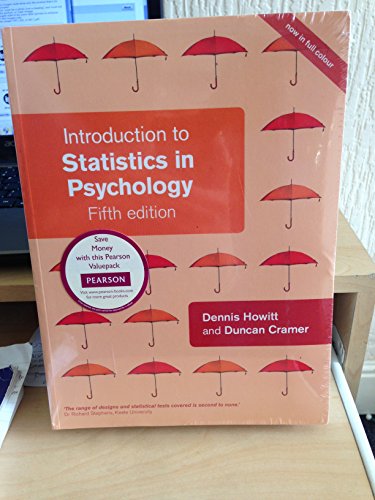
Introduction to Statistics in Psychology, 5th edition is the comprehensive, straightforward and essential student guide to understanding statistics and carrying out statistical analyses in psychology. Revised and updated throughout, the text offers clear and detailed coverage of the statistical methods used by psychologists. Key aspects of the process are highlighted throughout the text in special sections: * Research Design Issues' offers advice and guidance on important topics and concepts. * Examples from the published literature' highlight how tests have been applied in interesting classic and more recent research. * Calculation' presents and separates out the mathematical principles underlying the analyses. * Quick Steps Guide' - this new feature offers a practical, quick guide on how to carry out a statistical analysis in SPSS Statistics and helps students understand the links between the different tests. This book is supported by a companion website featuring a range of resource
Introduction to Statistics in Psychology
Statistics can be difficult, but this revised 3rd edition of Introduction to Statistics in Psychology makes it much easier. Any psychology student, whether at introductory, intermediate or advanced level will find the book a very useful companion to their statistics course.
Introduction to Statistics in Psychology is written in a jargon free style, it is comprehensive and accessible, and laid out with great visual clarity. Complex mathematics are kept to a minimum and concepts that are often difficult to grasp are explained step-by-step, using a wide variety of examples.
Introduction to Statistics in Psychology can be used alone or to complement the authors’ Introduction to Research Methods in Psychology and Introduction to SPPS in Psychology also published by Prentice Hall.
The revised 3rd edition:
- Provides a comprehensive guide to understanding a wide range of statistics
- Meets student needs at all stages of their course
- Teaches how to choose appropriate statistical tests
- Describes how to analyse data of all sorts
- Provides models of how to report findings
- Employs a flexible modular approach for effective study and reference
- Requires only a simple understanding of mathematics for success
- The best single resource for confidence intervals, statistical power, reliability, meta-analysis, log-linear and other advanced techniques
Dennis Howitt and Duncan Cramer are both Readers in Psychology at Loughborough University