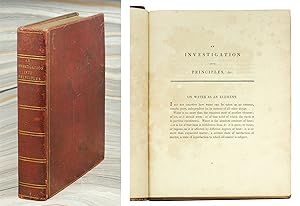
About this Item
[London : Dalla Stamperia di Gul. Bulmer, 1801]. Thick 4to, [2], [1], 1-721 pp. Printed in English and Italian. Contemporary red straight-grained goatskin, flat spine banded with double gilt rules, single gilt rule to the margins of the boards, all edges gilt, some foxing to the preliminaries, binding repaired and refurbished, still showing some scratches and stains, but still an attractive copy. ß Only edition, of absolute rarity (three copies recorded, none at auction,one in the marketplace bought by Yale). Maggs wrote of this copy: "Written by an associate of William Blake, this is a profoundly eccentric production, full of the revolutionary spirit of the times, combining mysticism, philosophy, electricity and magnetism. One of an unknown number of copies privately printed for the author, without a title page, by George Bulmer, all of them intended for presentation to the author s friends, this copy bearing the 19th Century ownership inscription Girdlestone , for whose identity there are several candidates, none completely convincing. It is in two parts, the first "An Investigation into Principles", written in English, is a series of reflections on the nature of elements, gravitation ( the pressure of the general ethereal fluid against our orb ), time ( Look for time in the vast expanse, Eternity will start to view, and time revolve no more ) tides, earthquakes and the lack of salt in rain (when raised into the sky by waterspouts, it is sweetened by the action of electricity). His logic is baffling at times, demonstrating the wisdom of a forward five year old or of an experienced haschischan : for instance he observes that gravity isn t all that Newton cracked it up to be, since water from a known principle in hydraulics rises to the top of mountains, which truth he derives from the fact that rivers never run dry. On the Barleycorn , is a dialogue between Mata and Ata based on a conversation [with George Finch, Earl of Winchilsea], concerning wisdom, folly, genius, reason, the individuality and the faculty of the soul. The second part is titled "On the Soul. On Magnetism. Magnetic Productions." and comprises the transcripts of Avena s automatic writings (see below), in Italian, many with English introductions, and some untranscribed writings dismissed as too confused to merit attention . There are a total 51 sessions in the first year, dated to Alessandria 1796 , 52 in the second year, and 27 in the third and last year. The last two years have almost no English narrative. In researching this book, we [Maggs] rely heavily on the intoxicating and brilliant essay by Marsha Schuchard "Blake s Healing Trio: Magnetism, Medicine, and Mania" published in Blake, an Illustrated Quarterly, Vol 23, Issue 1 which explores Blake s relationship with the eclectic network of illuminÈs, which included Swedenborgians, Freemasons, and Cabalists who shared his interest in animal magnetism spirit-communication, and erotic trances . George Baldwin was one of these, and is included, as Baldwin of Egypt s Lake in a vicious later (1808 - 1811) poem attacking their lack of commitment to his studies. Baldwin, born in 1744, was an author and diplomat who became very wealthy in the later years of the 18th century, establishing trade links for the East India Company with Egypt, owning a monopoly of the British trade route through Suez, demonstrating remarkable prescience about the importance to British trade of this route to the east. He was British Consul-General in Egypt from 1786 to 1796, in which position he warned the British Government of French plans to take over Egypt, a warning which was largely ignored. When the French invaded Egypt in 1798 he left the country for Italy, leaving behind substantial property in Alexandria, which was seized by the French. He was of considerable help in the planning of the British counter invasion, returning to Egypt in 1801 with the British forces, and claimed the credit for the decision to breach the canal in Ale.
Seller Inventory # 122733
Contact seller
Report this item