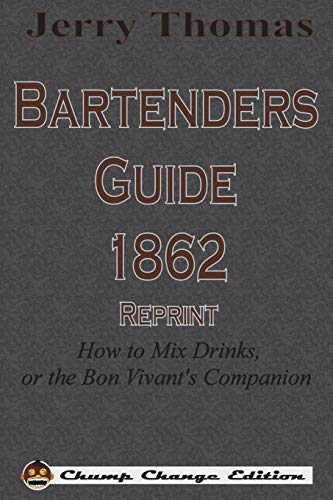
Unabridged text of the Jerry Thomas 1862 Bartenders Guide, offered here for chump change. It is considered the first cocktail book, and this reproduction is based on the first published edition.
This 1862 edition includes "A Manual for the Manufacture of Cordials, Liquors, Fancy Syrups, etc., etc." by Christian Schultz appended at the back, since any good bartender was supposed to know how to both mix and make.
Drinks include the Mint Julep and lesser known drinks like Absinthe Water, Flip, and Fix. One can use it to impress your friends making the Balaklava Nectar, Locomotive, and Blue Blazer.
Originals of the 1862 Jerry Thomas Bartender's Guide have been auction off for over $2,000, so buy this one and use the savings on practice!
Jeremiah (Jerry) P. Thomas (1830-1885) was an American bartender; because of his pioneering work in popularizing cocktails across the United States, he is considered "the father of American mixology." In addition to writing the seminal work on cocktails, his creativity and showmanship established the image of the bartender as a creative professional. As such, he was often nicknamed "Professor" Jerry Thomas. Thomas was born in 1830 in Sackets Harbor, New York. He learned bartending in New Haven, Connecticut before sailing for California during its mid-1800s Gold Rush. While in California he worked as a bartender, gold prospector and minstrel show manager. He moved back to New York City in 1851, where he opened a saloon below Barnum's American Museum; it would be the first of four saloons he would run in New York City over his lifetime. After a time running his first bar he went on the road for several years, working as the head bartender at hotels and saloons in St. Louis, Missouri, Chicago, Illinois, San Francisco, California, Charleston, South Carolina and New Orleans, Louisiana. At one point he toured Europe, carrying along a set of solid-silver bar tools. He was well known for his showmanship as a bartender: he developed elaborate and flashy techniques of mixing cocktails, sometimes while juggling bottles, cups and mixers. He often wore flashy jewelry and had bar tools and cups embellished with precious stones and metals. At the Occidental Hotel in San Francisco, Thomas was earning $100 a week-more than the Vice President of the United States. Upon returning to New York City, he became head bartender at the Metropolitan hotel before opening his most famous bar on Broadway, between 21st and 22nd Streets, in 1866. Thomas was one of the first to display the work of Thomas Nast, and in his famous saloon he hung caricatures of the political and theatrical figures; one notable drawing, now lost, was of Thomas "in nine tippling postures colossally". He died in New York City of apoplexy in 1885 at the age of 55. His death was marked by substantial obituaries across the United States. In their obituary, The New York Times noted Thomas was "at one time better known to club men and men about town than any other bartender in this city, and he was very popular among all classes."