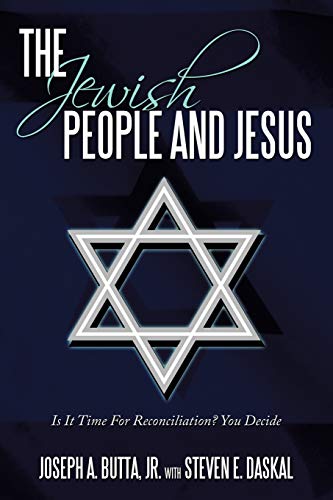
The Jewish People and Jesus
Is It Time For Reconciliation? You DecideBy Joseph A. Butta, Jr. Steven E. DaskalAuthorHouse
Copyright © 2010 Joseph A. Butta, Jr. with Steven E. Daskal
All right reserved.ISBN: 978-1-4520-3795-0 Contents
INTRODUCTION......................................................................................xviiSECTION 1: THE JEWISH PEOPLE, THEIR SAGES, AND THE PROPHETS.......................................1Chapter 1 Modern Jewish Opinion Concerning Reconciliation........................................3Chapter 2 Josephus, Maimonides, and Nachmanides Concerning Reconciliation........................27Chapter 3 The Talmud Weighs In On Reconciliation.................................................46Chapter 4 Does the Tenakh Equate To The Life Of Yeshua?..........................................73SECTION II: JEWISH DISCOURSE REGARDING THE NEW COVENANT, ST. PAUL, AND YESHUA.....................127Chapter 5 The New Covenant: Misrepresentation of Man or Inspired Writ of God.....................128Chapter 6 Christians: Followers of falsehood or adopted Sons of the Father?......................170Chapter 7 Paul: Hater of Judaism or Apostle of the Most High.....................................194Chapter 8 Yeshua: Fraud, Misguided Jew, or Son of God-Messiah of Israel..........................222CONCLUSION:.......................................................................................260BIBLIOGRAPHY......................................................................................261
Chapter One
Modern Jewish Opinion Concerning Reconciliation
OBJECTION: Jesus is the Christian Messiah (1)
RESPONSE: This term is redundant. It also insinuates that people who became followers of Yeshua were looking for a Messiah like Yeshua. The Messiah that first century Jews were looking for was the liberator/warrior King who would free the Jews of foreign bondage. The messiah that the Jewish believers in Yeshua accepted was a spiritual liberator who was to them not only the messiah of Israel but the redeemer of the world. These Jewish believers in Yeshua preached the story of the Jew Yeshua to non-Jews. In doing so they spoke of His impact on people's lives which to them were truths that Jewish believers and Gentiles could position against Greek stoicism and Roman paganism. Following Yeshua's example resulted in concrete benefits for the Gentile community. Spiritually these early believers could understand how the Yeshua story reconciled them with God. Also in practice it worked; therefore, people became believers.
SEGUE: The influence of Yeshua in history had an impact on the establishment of Hospitals, Universities, Literacy for all, Free enterprise, Separation of political powers in government, Liberty, Abolition of slavery, Science, Discovery of a new world, Elevation of women, Charity, High Standards of justice, Elevation of the common man, Condemnation of Adultery and homosexuality, Regard for human life, Civilizing primitive cultures, codifying languages, Inspiration for art and music, and the transformation of countless people from liabilities into assets. Did this have a positive impact on the formation of the United States? (2)
OBJECTION: Because the Jewish people rejected Jesus, the U.S. was able to develop into the most Christian, tolerant, and good-hearted country in history. (3)
RESPONSE: From the Christian perspective the Messiah had to be rejected by His own people first before He could return to those who rejected Him as their Messiah King. The Jewish rejection of Yeshua, coupled with large scale Gentile acceptance, led people in the more biblically literate nascent United States to develop uniquely among the nations because the words of Yeshua and his followers were read and practiced. From a Christian perspective it made no sense for God to bless the United States as a nation knowing that the majority of its citizens followed Yeshua, a deceiver, and the Apostles who were willing accomplices to this misrepresentation of truth. To believe the stated objection one must believe that Christians follow a fraud yet despite this; a good outcome has occurred. From another perspective had the Jews accepted Yeshua as Messiah and the Romans still put him to death, like bar Kochbah, (4) then Yeshua would have been proven false. Since the Judeans rejected Yeshua; He could not establish a Kingdom in violation of their will or violate the scriptures. From the Jewish perspective Yeshua did not bring eternal peace therefore He could not be the Holy One. From a Christian biblical perspective the Messiah had to be rejected by the Jewish people at that time. This rejection, foretold by the prophets and according to God's divine purpose, allows the Gentiles to accept the God of Abraham, Isaac and Jacob.
SEGUE: We have seen that reading and practicing the teachings of Yeshua have helped Gentile nations, especially the United States, develop into Just nations. The other so called "Christianized nations" who have persecuted the Jews and not followed the teachings of Yeshua have not developed to their potential. Since this is so, what other benefits did his teachings have for Gentiles?
OBJECTION: The Christian faith helps Gentiles have a relationship with God. (5)
RESPONSE: How is it possible for Christians to know the God of Israel and His will for the lives of Gentiles through someone who was a fraud? His followers would have also known that they were deceivers. The accounts of Yeshua resurrected were either true or not true. If their account of him was known deceit how then did Christians develop a relationship with the one true God?
SEGUE: Since the Christian faith has helped Gentile Christians to have a relationship with God why then does it seem that these Christians portray historical Jews in less then favorable light?
OBJECTION: It makes no sense why Mel Gibson vilified Jews in his film Passion of the Christ. (6)
RESPONSE: The Passion of the Christ was just that the story of the 12 hours leading up to Yeshua's execution. It pre-supposes that people are familiar with the story. Joseph A. Butta, Jr. with Steven E. Daskal In this light the film was made for believers and those searching for direction in their life. In Matt.21:12-13 Yeshua drives out the money lenders in the Temple. This makes the Scribes and Pharisees look bad and disrupts Temple commerce. In Matt.21:14-16 Chief Priests and Scribes become indignant after Yeshua heals people in the Temple especially after other Jews were referring to Yeshua as Hosanna Son of David. In Matt.21:23-46 Yeshua outwits the Chief Priests and Pharisees while quoting from Ps.118: 22-23 concerning their rejection of him. Yeshua did not expect to be accepted by them. This fulfilled the scripture that he quoted to them. In Matt.22 Yeshua informs the Judean leaders concerning the true intent of the scripture. This made them look bad in front of others. In Matt. 23 Yeshua seals their wrath against him by describing their hypocrisy. Yeshua predicts Jerusalem's demise and tells the Jews that they won't see him again until they say Baruch ha ba B'shem Adonai i.e. "Blessed is he who comes in the name of the Lord". (7) Until this happens among the Jewish people there will be no Messiah. When one is familiar with the story the telling of it makes obvious sense.
SEGUE: It is not inherently wrong to portray some Jewish Leaders in less than a favorable light if historically that depiction is accurate. The Tenakh portrays numerous occasions when some Jews behaved in ways that were not pleasing to God. (8)
OBJECTION: If enough Jews should depart from the true religion, Judaism, the whole people would suffer chastisement: violence and exile from the land of Israel. (9)
RESPONSE: In light of this statement and considering the events of 721 B.C.E., the Kingdom of Israel was exiled from the land. In 586 B.C.E., the Babylonians exiled the Kingdom of Judah from their land. How are we to interpret the events of 70 C.E. when the Romans destroyed Jerusalem and the Temple? In the events prior to 70 C.E. Yeshua was not an issue. The sons and daughters of Jacob were behaving like the pagan nations. Using this logic the Jewish people by 70 C.E. must have departed from true religion. Israel had rejected Yeshua. If Yeshua was the Messiah a case can be made that Israel abandoned true religion or the fulfillment of their faith by rejecting him. Today most Jews fall outside of orthodoxy. Should Jews who are atheists, agnostics, new agers, Marxists, and Buddhists be more of a concern to Jewry than Jews who have accepted Yeshua as the Messiah and strive to live their lives according to the Bible?
SEGUE: The point here is that the Jewish people suffered chastisement, violence, and exile after the Judeans rejected Yeshua. How do these events, the Jewish rejection of Yeshua, coincide with what Jewish people believe is true concerning the Messiah?
OBJECTION: The ingathering of Jews from the Diaspora came before the reign of Messiah. This precedes the establishment of the New Covenant (renewed commitment to Torah observance) spoken of in Jer.31. The New Temple would precede recognition of God by the non-Jews: (10)
RESPONSE: The ingathering could never have applied to Yeshua's day. Although many Jews did live outside the confines of Israel, Jewish people were firmly established in Judea and Samaria. Another great Diaspora was to be initiated in 70 C.E. and be completed by 135 C.E. The ingathering has happened in our day, so by this rendering we are getting close. Yeshua claimed to establish a New Covenant. This has been accepted by over 2 billion including 200,000 Jewish believers (11). Those who accept His teaching worship the Hebrew God. Stating that the New Temple precedes non-Jews recognizing God is simply not true. One of the previous Objections stated that Christian faith helps Gentiles have a relationship with God. Furthermore if this is true why do the Jews of Israel continue to deny permission for the Temple to be rebuilt? Don't they believe that this is the final ingathering? (12)
SEGUE: What we have established so far is that Jewish people were already in Judea and Samaria like they are today in modern day Israel. The difference was of course the Roman occupation. In contemporary times the Arabs control part of the land that encompassed ancient Israel. What we can say is that most Jews live outside of Israel and that 2 billion people claim allegiance to a faith that worships the God of the Hebrews. If we know this to be true, what then is the central issue why Jewish people oppose reading the New Covenant and accepting it at face value?
OBJECTION: Jewish scholars do not find any substantial points of disagreement between Jesus and his contemporaries. What Jesus rejected was the oral Torah that explains the written Torah (13)
RESPONSE: In Mark 7: 6-13 it is clear from the New Covenant text that Yeshua's message concerned the intent of the heart. Volumes of commentary concerning the books of Moses meant nothing if they contradicted the intent of the written word or if the explanation did not take into account what Yeshua called the two Great Commandments. In Matt.22: 36-40 the commandments that Yeshua described can be found in Deut.6:5 and Lev.19:18. The issue then rests on the Torah being a cryptic document that can only be revealed by a key that unlocked this code. In our day we see a code being unlocked in terms of the Bible codes, but commentary on the written word is not lifted to the level of the written word of God unless the written word acknowledges that the commentary, oral tradition, must be adhered to and encompasses the authority of the written word of God. Moses does not speak of this oral tradition being valued as the revelation that he received from God. It should be noted that the Sadducees also rejected the authority of the Oral Law. The wrath of the Pharisees came against Yeshua because he accused the Pharisees of being "blind guides" who placed unreasonable burdens on the people and did nothing to lift this burden. The standard therefore is weighed against the essence of the law found in Deut.6:5 and Lev.19:18. You shall love Yahveh your God with all your heart, with all your soul, and with all your might. You shall love your neighbor as you love yourself.
SEGUE: Must a person faithfully observe the words of the Oral Torah, Jewish tradition, in order to observe the intent of Deut.6:5 and Lev.19:18? Could the words of God through Moses stand on their own merit without the commentary of the Rabbi's? If not, should the words of these Sages be lifted to speak with the authority of Moses since the written Torah does not state that it can only be interpreted via an Oral Torah that was revealed at Sinai as well? What did God mean when he proclaimed that his commandments must be obeyed?
OBJECTION: It is a fact that the practice of the commandments is a discipline unsuited to the requirements of a mass religion. (14)
RESPONSE: In Isa.42 God speaks of bringing his justice to the Nations (Gentiles). If the practice of the commandments is unsuitable to the requirements of a mass religion what then is God's intention concerning the Gentiles? How was bringing God's justice to the Gentiles supposed to happen under the old formula? The truth is it could not happen under the old formula, the Mosaic Law interpreted by the Oral Law or tradition. Since it could not happen under the old formula, but has happened through the teaching of Yeshua communicated to the Gentiles by St. Paul one must consider that God's justice has been communicated to the Gentiles through the Jewish followers of Yeshua.
SEGUE: Since it is established that Yeshua's teaching and example allowed non-Jews to understand their salvation history, is it possible that Jewish people hold other failed messiah's in higher esteem than Yeshua? We cannot call Yeshua's mission failed since he promised to return and since his teaching inspired a worldwide movement that has been with us 2000 years. Failed Jewish messiah's did not promise to return and did not inspire a major world faith.
OBJECTION: Simeon Bar Kochbah, hailed as the greatest sage of the day by Rabbi Akiva, was a failed messiah killed by the Romans at the siege of Beitar. He secured Jerusalem for two years and started Temple construction ... Akiva and other Rabbi's were prepared to follow him. Bar Kockbah got things done. He led an uprising ... until the presumptive messiah's death. Akiva had been overhasty. (15)
RESPONSE: In the Jewish mind Bar Kochbah commands a higher standing than the Nazarene Yeshua. Yet the Rabbi's of Bar Kochbah's day got it wrong. Rabbi Akiva was not a prophet. He hailed Simon Bar Kochbah as the greatest sage of his day. Rabbi Akiva thought Bar Kochbah to be the messiah. They were both wrong. After Bar Kochbah's death, how many Jews continued to follow him? Is it possible if this rabbi got it wrong concerning Bar Kochbah that he and other rabbis could also be wrong concerning the suffering servant of Isa.53?
SEGUE: If a rabbi and others got it wrong concerning Bar Kochbah could they also be incorrect concerning the perception that Jews living under an Islamic administration had it better. History has already taught us that Jews suffered greatly at the hands of professing Christians who did not live their lives according to the teachings of Yeshua.
OBJECTION: In 755 the Umayyad dynasty was established in Spain. It created a haven for Jews on the Iberian Peninsula. These "good times" lasted until 1013. (16)
RESPONSE: Although this is true one must not think that Jewish Muslim relations before this period were not without Jewish suffering.
624: Tabari VII 87; Bukhari V5B59N362; Ishaq 364 -The Banu Qaynuqa surrendered, they were exiled from Medina and sent into the desert. (17)
626: Ishaq VII 159; Ishaq 438 - Muhammad besieged the Banu Nadir Jews for 15 days. In return for their lives the Jews relinquished their possessions and property to Muhammad and were expelled from their land. Muhammad then declared and Allah promised that all of the Jews would be condemned. (18)
627: Tabari VIII 6-40; Ishaq 450-480- At the Battle of the Ditch, where the Meccans were defeated at Medina, Allah commanded Muhammad to march against the Qurayza Jews. After a 25 day siege Muhammad commanded the Jews to submit to Sa'd Mu'adh's judgment. They agreed in order to end the siege. After death was decreed, Muhammad ordered all males over puberty beheaded. 900 Jewish male captives were decapitated in the presence of Muhammad and the Jewish victim's mothers, sisters, wives, aunts, and children. The Prophet then took Rayhana, who just witnessed the death of her Father & Brothers, for Himself. She became his concubine. (19)
629: Ishaq 510-515; Tab VIII 116-123- Muhammad laid siege to Khaybar and surrounding towns for 19 days. All the men were executed. Their women were given to the Muslims and the children were sold into slavery. (20)
Tab VIII 129,130- After hearing the fate of the Khaybar Jews the Fadak Jews agree to give Muhammad 1/2 of all they produced. Umar would later expel them from Arabia. (21)
634: 4000 Jews & Christians massacred from Gaza to Caesarea.
643: Jews & Christians at Tripoli must forfeit their women and children; The population of Carthage was slaughtered.
853-859: Caliph Mutawakkil ordered all new churches in Egypt destroyed. Synagogues destroyed throughout Mesopotamia.
892: 40,000 Jews confirmed expelled from Caesarea during earlier Jihad
With the demise of the Umayyad dynasty and the eventual arrival of the Almohads Jewish suffering under Islam would intensify through the reconquista of Christian Spain.
1010 - 1013: Purge of Jews in Cordoba, Spain.
1014: Synagogues ordered destroyed in Egypt and Syria.
1033: 6000 Jews in Fez, Morocco executed.
1065: Jews forced to convert or die in Yemen.
1066: 3000 Jews in Granada slaughtered; most churches in Spain destroyed.
1077: Seljuk Emir Atsiz bin Uwaq murders 3000 Jews/ Christians in Jerusalem
1148: Nur-ed-Din orders every Christian killed at Aleppo, Syria; Spanish Jews threatened with Conversion or deportation.
1159: Jews & Christians in Tunis were given a choice between Islam or death.
1275: Jews forced to convert or die in Morocco.
1291, 1338: Jews forcibly converted at Tabriz.
1293-94;1301-2: Synagogues destroyed in Egypt and Syria.
1333, 44: Jews forced to convert or die in Baghdad.
1465: Muslim mobs at Fez kill thousands of Jews leaving 11 alive. (22)
SEGUE: Now that we've seen that Jewish existence in the lands that Muslims conquered was not preferable to lands where the majority were Christians an important distinction must be made. Muhammad and his followers did violence to Jews within two years of living among them. Yeshua and his followers did no violence to Jews nor taught others to do violence to the Jewish People. It is true that professing Christians did violence to Jewish people. We don't see large scale examples of this until the latter part of the 12th century in Europe. However, discrimination and hostility towards the Jews in the land of professing Christians goes back to the 6th century. When it was done it was always done in total disregard of Yeshua's teaching and the preaching of the evangelists and disciples of the early church. With this being established how do biblical Christians view God's relationship with the Jewish people?
OBJECTION: Christians deny the covenant with Israel and the commandments from Sinai. (23)
(Continues...)
Excerpted from The Jewish People and Jesusby Joseph A. Butta, Jr. Steven E. Daskal Copyright © 2010 by Joseph A. Butta, Jr. with Steven E. Daskal. Excerpted by permission.
All rights reserved. No part of this excerpt may be reproduced or reprinted without permission in writing from the publisher.
Excerpts are provided by Dial-A-Book Inc. solely for the personal use of visitors to this web site.