

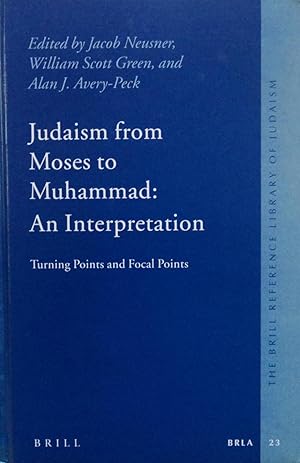
Judaism from Moses to Muhammad: An Interpretation (Brill Reference Library of Judaism)
Neusner, Jacob, (Editor), and Green, Lezlie C (Editor), and Avery-Peck, Alan (Editor)
ISBN 10: 9004145133 ISBN 13: 9789004145139
Published by Brill Academic Publishers, 2005
Used
Hardcover
From
School Haus Books, Saginaw, MI, U.S.A.
Seller rating 5 out of 5 stars

AbeBooks Seller since November 5, 2003
This specific item is no longer available.
About this Item
Description:
2005 hardcover published without jacket/minor bumping on the cover/clean & unmarked. 354 p. Seller Inventory # ABE-1567900614114
Synopsis:
This book answers the following question for Judaism: among all the things that happened in antiquity, what are the events that, seen from the perspective of the world that would endure, turn out to shape the long future? How did axiological events identify the focal points of the unfolding religious system, Judaism, in its formulation by the rabbinic sages of ancient times? This is the system that originated, in its own telling, with God’s teaching to Moses at Sinai in the Torah, in written and traditional form. Of all that happened to the Jews in the millennium from the formation of the Pentateuch (“Moses”) to the end of the formative age (“Muhammad”), the particular Judaism that emerged as normative responded to only a select few and did so within a logic all its own. Here we identify those definitive events of danger and opportunity ― crisis ― and the focal points that they highlighted.
About the Author:
Jacob Neusner is Research Professor of Religion and Theology at Bard College, Annandale-on-Hudson, New York. He is also a Life Member of Clare Hall, Cambridge University, and a Member of the Institute for Advanced Study in Princeton, New Jersey.
William Scott Green is Professor of Religion, Philip S. Bernstein Professor of Judaic Studies, Dean of the College, University of Rochester.
Alan J. Avery-Peck is Kraft-Hiatt Professor in Judaic Studies in the Religious Studies Department of the College of the Holy Cross, Worcester, Massachusetts. Alongside his many publications on Rabbinic Judaism, he is editor of Review of Rabbinic Judaism: Ancient, Medieval and Modern (Brill).
"About this title" may belong to another edition of this title.
Bibliographic Details
Title: Judaism from Moses to Muhammad: An ...
Publisher: Brill Academic Publishers
Publication Date: 2005
Binding: Hardcover
Condition: Very Good
Dust Jacket Condition: No Jacket