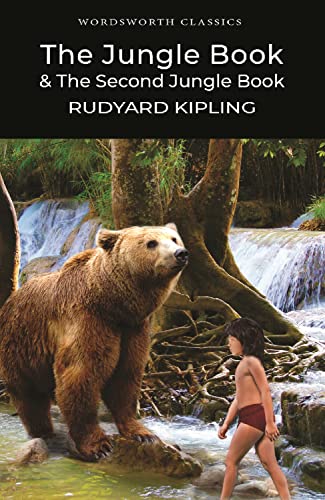
The Jungle Book introduces Mowgli, the human foundling adopted by a family of wolves. It tells of the enmity between him and the tiger Shere Khan, who killed Mowgli's parents, and of the friendship between the man-cub and Bagheera, the black panther, and Baloo, the sleepy brown bear, who instructs Mowgli in the Laws of the Jungle.
The Second Jungle Book contains some of the most thrilling of the Mowgli stories. It includes Red Dog, in which Mowgli forms an unlikely alliance with the python Kaa, How Fear Came and Letting in the Jungle as well as The Spring Running, which brings Mowgli to manhood and the realisation that he must leave Bagheera, Baloo and his other friends for the world of man.
Rudyard Kipling is best known for his works of fiction, including The Story of the Gadsbys (1888), The Phantom Rickshaw and other Eerie Tales (1888) The Seven Seas (1896), Captains Courageous (1897), Kim (1901), and Just So Stories (1902); also many short stories, including The Man Who Would Be King (1888), Puck of Pook's Hill (1906), Rewards and Fairies (1910) and his poems, including Mandalay (1890), Gunga Din (1890), The White Man's Burden (1899) and ‘If’ (1910). He is regarded as a major innovator in the art of the short story. In addition to those works of Kipling which are in bold type, Wordsworth Editions publish, The Best Short Stories, Collected Poems, and Strange Tales. Widely regarded as the unofficial Poet Laureate, some people claim he was offered this post, but refused it, along with other honours, including the Order of Merit. After he received the Nobel Prize for Literture (1907), his output of poetry and fiction declined. Between 1922 and 1925 he was rector at the University of St Andrews. He died on 18 January, 1936 and was buried in Poet’s Corner at Westminster Abbey.