
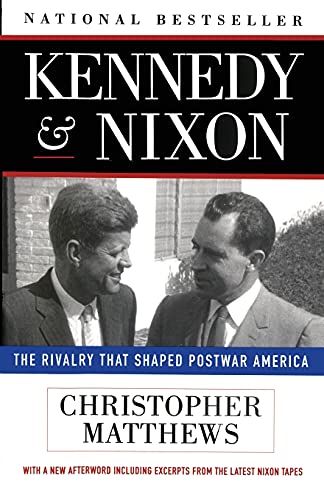
Kennedy and Nixon: The Rivalry That Shaped Postwar America
Matthews, Christopher J
ISBN 10: 0684832461 ISBN 13: 9780684832463
Published by Free Press, 1997
Used
paperback
From
HPB Inc., Dallas, TX, U.S.A.
Seller rating 5 out of 5 stars

AbeBooks Seller since September 15, 2017
This specific item is no longer available.
About this Item
Description:
Connecting readers with great books since 1972! Used books may not include companion materials, and may have some shelf wear or limited writing. We ship orders daily and Customer Service is our top priority! Seller Inventory # S_455717036
Synopsis:
John Kennedy and Richard Nixon shared a dream of being the great young leader of their age. But what drove history, as this work sets out to show, was the enmity between these two figures, whose 1960 presidential contest would set the nation's bitter course for years to come.
Excerpt. © Reprinted by permission. All rights reserved.:
Kennedy Nixon
The Rivalry That Shaped Postwar AmericaBy Christopher MatthewsFree Press
Copyright © 1997 Christopher MatthewsAll right reserved.
ISBN: 9780684832463
Chapter One
World War II Was
Their Greatest
Campaign Manager
In April 1945, as Adolf Hitler and mistress Eva Braunspent their last days in a Berlin bunker, the celebrating in SanFrancisco had already begun. From Washington, London, andMoscow, the Allies converged for the first great pageant of victory.Artie Shaw had taught his band every national anthem, evenscoring one for Saudi Arabia, whose strict Muslim royalty sawthe composition as blasphemy. Pianist Arthur Rubinstein andNew York Metropolitan Opera star Ezio Pinza were at the SanFrancisco Opera House, where Secretary-General Alger Hiss waspreparing for the inaugural session of the new United Nations.Hotel lobbies bustled with the arrival of the men World War IIhad made celebrities. Up on Nob Hill, the American secretaryof state, Edward Stettinius, held court at the Fairmont penthouse.Several floors down, aide Adlai Stevenson leaked somuch news his room was christened "Operation Titanic." Atthe St. Francis, young assistant secretary Nelson Rockefellerhosted an around-the-clock reception for Latin Americandelegates. Up on the tenth floor, the conference's most mysteriousdelegation, the Soviet mission, headed by Vyacheslav M. Molotov,had rifle-toting guards posted from one end of the hall to theother.
Everyone guessed at Moscow's intentions. Would America's"great Russian allies" cooperate in the new postwar order or resortto their pre-1941 truculence? At a Palace Hotel suite, Kremlinexpert Charles "Chip" Bohlen gave a briefing one evening on thesituation he had just left behind in Moscow. The prestigious groupincluded top British envoy Anthony Eden and U.S. Ambassadorto the Soviet Union Averell Harriman. At one point in Bohlen'stalk, Harriman went out on the balcony with a young woman. "Igive him about two more minutes, and then he's going to hanghimself," Jack Kennedy, the twenty-seven-year-old host of thegathering, whispered to his navy pal Paul "Red" Fay. "What doyou mean?" Fay asked, thinking that Kennedy was talking aboutthe briefing they were getting from the Soviet expert. "I'm nottalking about Bohlen," Kennedy corrected him. "I'm talkingabout Harriman."
"That's pretty much the way it was," agreed Chuck Spalding,another Kennedy pal along for the fun. "Jack's attitude, as it wasin so many other crises, made you feel you were at a fair or something."Kennedy, a stringer for the Chicago Herald American, wassomething of a celebrity himself due to his wealthy father's controversialtenure as U.S. ambassador to Great Britain in the prewaryears and his own publicized exploit in the South Pacific, saving hiscrew after his PT boat was rammed in half by a Japanese destroyer.
Like other returned servicemen, Kennedy worried that an ailingPresident Roosevelt, dead just two weeks, had conceded too muchto Joseph Stalin during the recent Allied meeting at Yalta. Thestone-faced Soviet delegation attending the UN conference onlyadded to the sense of postwar menace. "Americans can now seethat we have a long way to go before Russia will entrust her safetyto any organization other than the Red Army," Kennedy wroteafter covering a Molotov press conference. "The Russians mayhave forgiven, but they haven't forgotten."
The Hearst reporter had his own postwar agenda: politics. Hisolder brother, Joseph Kennedy, Jr., had been killed in a bombingmission the year before, leaving the hopes of Joseph Kennedy, Sr.,riding on his second oldest. The job covering the UN conference,a plum assignment won through his father's friendship with WilliamRandolph Hearst himself, was a warm-up for what Jack calledhis dad's scheme to "parlay a lost PT boat and a bad back into apolitical advantage." His weeks covering the UN conferencewould teach Kennedy the superiority of his father's plan to hisown notion of becoming a full-time journalist. He learned thehard way that the statesmen passing through the hotel lobbies ofSan Francisco carried far more prestige than those milling aroundtrying to snag interviews. Red Fay, who had convinced his navysuperiors to let him accompany his mustered-out pal to San Francisco,recalled a telling incident from those days and nights inSan Francisco. "He had this attractive gal, and—I will neverforget—somebody came in and ran his hand through Jack's hairand was very condescending. I've never seen Jack so mad." Kennedywas learning firsthand the lack of respect shown to lowlyreporters, even well connected ones. When word came that hisfather had persuaded, with the help of a huge financial gift, thelegendary James Michael Curley to give up his seat in the U.S.Congress and run again for mayor of Boston, young Kennedy wasready for the leap. "I've made up my mind," Kennedy toldSpalding not long after. "I'm going into politics."
Continues...
Excerpted from Kennedy Nixonby Christopher Matthews Copyright © 1997 by Christopher Matthews. Excerpted by permission.
All rights reserved. No part of this excerpt may be reproduced or reprinted without permission in writing from the publisher.
Excerpts are provided by Dial-A-Book Inc. solely for the personal use of visitors to this web site.
"About this title" may belong to another edition of this title.
Bibliographic Details
Title: Kennedy and Nixon: The Rivalry That Shaped ...
Publisher: Free Press
Publication Date: 1997
Binding: paperback
Condition: Very Good