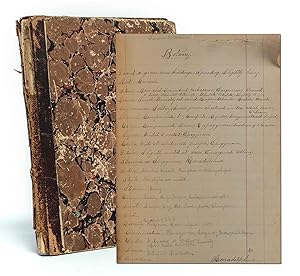
Keystone Normal School Course Notebook
[Women in Education] Fannie S. Hottenstein
Sold by Whitmore Rare Books, Inc. -- ABAA, ILAB, Pasadena, CA, U.S.A.
Association Member:
AbeBooks Seller since March 8, 2010
Sold by Whitmore Rare Books, Inc. -- ABAA, ILAB, Pasadena, CA, U.S.A.
Association Member:
AbeBooks Seller since March 8, 2010
Quarter roan over marbled boards measuring 8 x 6.25 inches and comprised of 73 pages of manuscript text (including a mixture of notes passed between friends on the verso of the final leaf and on the rear pastedown). Spine largely perished with boards and textblock held together by cords. Several leaves neatly excised towards rear. Containing notes from Fannie Hottenstein's courses in teacher training, the present volumes offer researchers a range of study topics, including the history of pedagogy and women's increasingly visible place in American education; the book also is a valuable resource for examining how educated young women were thinking through their own lives and roles -- as individuals and as a generation. Trained in one of the most educationally progressive states at the time, Fannie Hottenstein was one of a generation of women who could more widely dream about and pursue more independent lives than their matriarchs. Historically, Pennsylvania had been a vanguard for public and progressive education. "In his 1830 address to the state legislature, Governor George Wold championed the cause of universal public education" as a scaffold for "the security and stability of the individual privileges we have inherited from our ancestors" (Explore History). Before the decade was over, "more than 1,000 local school districts under a single statewide system of instruction" had been founded, working to regularize "educational standards, curriculum, and instructional credentials" in tandem with the 1857 Normal School Act which founded "a network of ten state academies to prepare public school teachers" (Explore History). Fannie attended one of these, preparing for a career in education that would give her a new level of social and economic independence. Much of Fannie's notebook reflects the kind of rigorous work required to teach middle and high school students. Contents include, for example, three pages of facts on basic Botany; fifteen pages on the practice of Logic in writing and debate, including an extensive section on presenting proper Opposition (accompanied by text book page numbers); and five pages on pedagogical methods for helping students develop curiosity and drive it forward into productive study. There are additional, fairly staid, essay samples on topics such as Influence and Gentleness. Yet it is in the thirteen page essay We Girls that sparks of Fannie's individuality, ambition, and independence show. In it, she reveals how much contact she has had with the period's literature on women's rights and suffrage; she shows her familiarity with anti-feminist arguments in opposition to women like her; and she powerfully expresses her hopes not only for her generation but the ones that follow. Fannie opens: "It is a recognized fact that the degree of civilization of every nation is marked by the social position of woman. Indeed, one of the most prominent features of the progress of civilization is her gradual elevation in society and the clear perception and recognition of her rights. In the earlier ages of the world, when the sphere of her influence was bounded by the narrow prejudices of the opposite sex, her happiness as well as her mental improvement and social rank depended more on what was done for her at the hands of men than on what she could do for herself. All this is changed now." Fannie praises the hard-won changes women accomplished in accessing education and job training; and she touts how many opportunities are available for women to dream about and pursue. This does not mean she's unaware of the challenges that continue -- particularly from men. "We have to contend with the prejudice sometimes entertained against us, that our highest destiny in life is to be a pretty piece of furniture in a handsome parlor. Men who entertain this notion, we girls must always urge to get their furniture somewhere else." To those who accuse women of being too emotional and insufficiently intellectual, she also has a resp.
Seller Inventory # 5955
We guarantee the condition of every book as it's described on the Abebooks web sites. If you're dissatisfied with your purchase (Incorrect Book/Not as Described/Damaged) or if the order hasn't arrived, you're eligible for a refund within 30 days of the estimated delivery date. If you've changed your mind about a book that you've ordered, please use the Ask bookseller a question link to contact us and we'll respond within 2 business days.
Whitmore Rare Books, Inc.
121 E. Union St.
Pasadena, Ca 91...
Orders usually ship within 2 business days. Shipping costs are based on shipping speeds and book weight. If your book order is heavy or oversized, we may contact you to let you know extra shipping is required.
| Order quantity | 2 to 5 business days | 2 to 3 business days |
|---|---|---|
| First item | US$ 20.00 | US$ 35.00 |
Delivery times are set by sellers and vary by carrier and location. Orders passing through Customs may face delays and buyers are responsible for any associated duties or fees. Sellers may contact you regarding additional charges to cover any increased costs to ship your items.