Synopsis
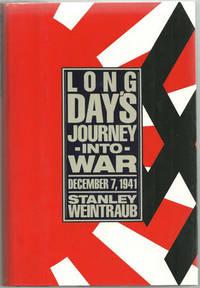
Presents a global analysis of the twenty-four hours that thrust the United States into World War II, featuring interviews with survivors and a detailed countdown of events that led to the attack on Pearl Harbor
Reviews
Weintraub's "long day" is essentially the weekend in 1941 that included Pearl Harbor Sunday. With consummate skill he weaves together anecdotal material from around the world to describe events in that momentous span of time. He includes narrative snapshots from the Nazi death camps and the war fronts in Russia, North Africa and Southeast Asia, as well as governmental and civil doings in Washington, London, Berlin, Moscow, Rome, Tokyo, Singapore, Honolulu and elsewhere. Signs of imminent war between Japan and the United States accelerate and messages marked "extremely urgent" cross paths in both hemispheres. In addition to focusing on such grand-scale historical figures as Roosevelt, Churchill, Hirohito and Hitler, Weintraub also shines a spotlight on such folk as Army Private James Jones who later fictionalized his Pearl Harbor Day experiences in From Here to Eternity ; poet Ezra Pound, who made a pro-fascist broadcast in Italy that weekend; fighter ace Saburo Sakai, who added American planes to his already impressive tally during the invasion of the Philippines that weekend; and songwriter/singer Woody Guthrie, who helped defuse a racial confrontation in Los Angeles. The centerpiece, however, is the bombing of Pearl Harbor by the Japanese, and Weintraub provides an awe-inspiring account of the December 7 attack and its psychological aftermath. This is an ambitious and stunningly successful hour-by-hour chronicle of what may be the most memorable weekend in modern history. Weintraub is the author of A Stillness Heard Round the World: The End of the Great War. BOMC and History Book Club selections.
Copyright 1991 Reed Business Information, Inc.
Galvanic, hour-by-hour account that traces the events leading up to and following the Japanese attack on Pearl Harbor. Pennsylvania State Univ. arts-and-humanities professor Weintraub (Victoria, 1987, etc.), who recounted the final days of the Great War in A Stillness Heard Round the World (1985), details how the simultaneous Japanese attacks on American and British forces in the Pacific and Asia suddenly plunged millions into arguably the first truly global conflict. With brief snapshots, he illustrates how both ordinary and powerful people experience the mounting horror in far-flung locales--Washington, Manila, Moscow, Tokyo, Tobruk, Singapore, London, Berlin, and, of course, Hawaii. Cryptographers and junior naval functionaries sense something amiss, only to see their warnings ignored by top brass; an urgent plea for peace from FDR to Hirohito is delayed for ten hours by Japanese warmongers; a group of scientists meet in a coffee shop to discuss the atomic bomb; German forces bog down in the Soviet Union and North Africa; Hitler pops open champagne to celebrate Pearl Harbor, then later takes an ominous step closer to the Final Solution with the ``Night and Fog Decree.'' This structure emphasizes the dizzying speed of events, accurately mirroring the chaos. One caveat: Weintraub's research seems herculean, but his skeletal endnotes list only his primary sources, not secondary sources, for the interested reader. A dazzling example of historical narrative, revealing the almost infinite variety of human responses--courage, fear, intelligence, idiocy, outrage, and sorrow--as the world trembled on the brink of war. (B&w photographs--not seen.) -- Copyright ©1991, Kirkus Associates, LP. All rights reserved.
Weintraub has a knack for presenting a kaleidoscopic view of the great pivot points of modern history. In this book he takes the reader hour by hour through the fateful weekend which changed the balance of World War II. This is far more than another reprise of the Pearl Harbor disaster, however. Weintraub's fast-moving narrative shifts from scene to scene across the entire globe as events march to their climaxes throughout the South Pacific, and from the snows of Russia to the North African desert. The emphasis is always upon ordinary people caught up in overwhelming events. The author follows much the same format as in his treatment of the last days of World War I, A Stillness Heard Round the World ( LJ 8/85). In concept and readability, the book compares well with William K. Klingaman's chatty social history of the period, 1941: Our Lives in a World on the Edge ( LJ 10/1/88). Recommended. BOMC selection.
- Raymond L. Puffer, U.S. Air Force History Prog., Los Angeles
Copyright 1991 Reed Business Information, Inc.
"About this title" may belong to another edition of this title.