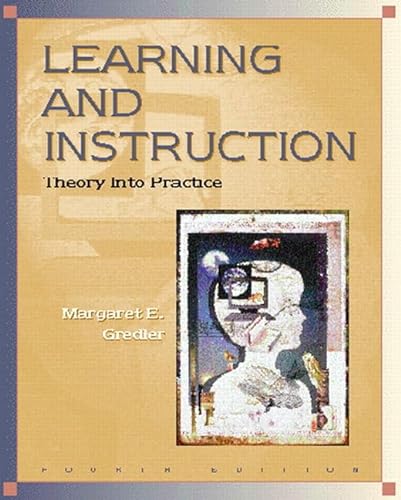
This well-organized book offers superior coverage of contemporary learning theories and their application to educational practice. A favorite among learners, it translates basic assumptions and principles of two earlier theories and seven contemporary learning theories into understandable concepts. The author discusses issues related to each of the seven theories including readiness, motivation, problem solving, and the social context for learning. It contains more than 100 references that reflect up-to-date content and research—such as the latest implications of brain research, constructivism, intrinsic and extrinsic motivation, and new developments in meta-cognition and problem solving. Special focus is given to Vygotsky's theory and the role of the teacher and subject matter learning in cognitive development. The major theoretical trend of neuroscience from 1990 to the present is also profiled. For education and psychology professionals interested in human learning theory—in practice.
Learning and Instruction contains comprehensive coverage of all learning theory perspectives from behavioral to cognitive to social constructivist. Gredler's text takes a models approach by presenting separate chapters on individual theories and perspectives such as Piaget, Weiner, and Bandura.
- Each major theory chapter now contains a new section titled "Relationships to Other Perspectives" that compares and contrasts each perspective with other theories of learning.
- This edition now includes a current examination of neuroscience's contributions to learning theories.
- The new Chapter 10 clarifies the concepts in Vygotsky's theory, specifically the role of the teacher and subject matter learning in cognitive development.
- The text very clearly translates basic assumptions and principles into understandable guidelines for classroom instruction.