
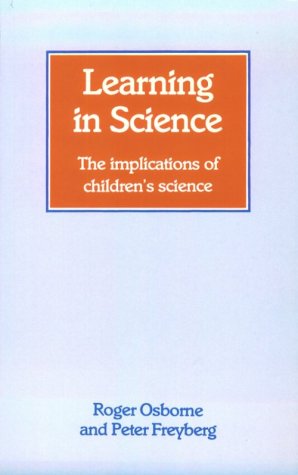
Learning in Science: The Implications of Children's Science
Peter Freyberg
ISBN 10: 0868632759 ISBN 13: 9780868632759
Published by Heinemann Educational Books, 1985
Used
Paperback
From
WorldofBooks, Goring-By-Sea, WS, United Kingdom
Seller rating 5 out of 5 stars

AbeBooks Seller since March 16, 2007
This specific item is no longer available.
About this Item
Description:
The book has been read, but is in excellent condition. Pages are intact and not marred by notes or highlighting. The spine remains undamaged. Seller Inventory # GOR004496432
Synopsis:
This book is about the way in which children learn science and the notions about science that they bring to the classroom. The authors reveal that all children develop ideas about science and concepts about how the world works before they come to school. This is simply a child's way of dealing with his environment. So often science teaching takes no account of this built in knowledge, but dismisses it as incorrect.
Here the authors suggest that a teacher's more productive strategy is to accept that children have certain concepts, and then to build on those as a stepping stone towards more sophisticated and "correct" learning. They propose convincingly that science is seen as a difficult subject largely because the teacher traditionally expends so much effort on combating a child's existing knowledge.
A central concern of the book is with teaching students age 10 15, though the issues are relevant to all age levels.
"About this title" may belong to another edition of this title.
Bibliographic Details
Title: Learning in Science: The Implications of ...
Publisher: Heinemann Educational Books
Publication Date: 1985
Binding: Paperback
Condition: Very Good