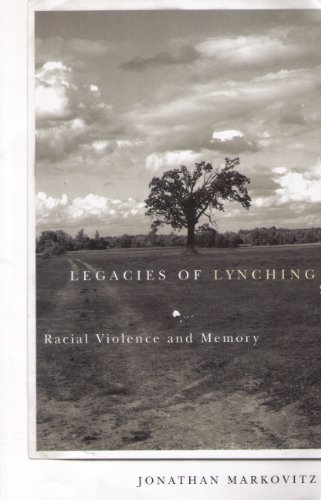
Legacies Of Lynching: Racial Violence And Memory
Jonathan Markovitz
Sold by Kennys Bookstore, Olney, MD, U.S.A.
AbeBooks Seller since October 9, 2009
New - Soft cover
Condition: New
Ships within U.S.A.
Quantity: Over 20 available
Add to basketSold by Kennys Bookstore, Olney, MD, U.S.A.
AbeBooks Seller since October 9, 2009
Condition: New
Quantity: Over 20 available
Add to basketNum Pages: 280 pages, Illustrations, ports. BIC Classification: 1KBB; JFFJ; JFSL. Category: (G) General (US: Trade); (U) Tertiary Education (US: College). Dimension: 226 x 153 x 14. Weight in Grams: 363. . 2004. First Edition. Paperback. . . . . Books ship from the US and Ireland.
Seller Inventory # V9780816639953
Traces the changing meanings of lynching and examines the political power of lynching as metaphor
Between 1880 and 1930, thousands of African Americans were lynched in the United States. Beyond the horrific violence inflicted on these individuals, lynching terrorized whole communities and became a defining characteristic of Southern race relations in the Jim Crow era. As spectacle, lynching was intended to serve as a symbol of white supremacy. Yet, Jonathan Markovitz notes, the act's symbolic power has endured long after the practice of lynching has largely faded away.
Legacies of Lynching examines the evolution of lynching as a symbol of racial hatred and a metaphor for race relations in popular culture, art, literature, and political speech. Markovitz credits the efforts of the antilynching movement with helping to ensure that lynching would be understood not as a method of punishment for black rapists but as a terrorist practice that provided stark evidence of the brutality of Southern racism and as America’s most vivid symbol of racial oppression. Cinematic representations of lynching, from Birth of a Nation to Do the Right Thing, he contends, further transform the ways that American audiences remember and understand lynching, as have disturbing recent cases in which alleged or actual acts of racial violence reconfigured stereotypes of black criminality. Markovitz further reveals how lynching imagery has been politicized in contemporary society with the example of Clarence Thomas, who condemned the Senate's investigation into allegations of sexual harassment during his Supreme Court confirmation hearings as a “high-tech lynching.”Even today, as revealed by the 1998 dragging death of James Byrd in Jasper, Texas, and the national soul-searching it precipitated, lynching continues to pervade America's collective memory. Markovitz concludes with an analysis of debates about a recent exhibition of photographs of lynchings, suggesting again how lynching as metaphor remains always in the background of our national discussions of race and racial relations.Jonathan Markovitz is a lecturer in sociology at the University of California, San Diego.
"About this title" may belong to another edition of this title.
We guarantee the condition of every book as it's described on the Abebooks websites.
If you're dissatisfied with your purchase (Incorrect Book/Not as Described/Damaged) or if the order hasn't arrived, you're eligible for a refund within 30 days of the estimated delivery date.
For any queries please use the contact seller link or send an email to books@kennys.ie
Conor Kenny
All books securely packaged. Some books ship from Ireland.
| Order quantity | 14 to 20 business days | 13 to 14 business days |
|---|---|---|
| First item | US$ 10.50 | US$ 21.00 |
Delivery times are set by sellers and vary by carrier and location. Orders passing through Customs may face delays and buyers are responsible for any associated duties or fees. Sellers may contact you regarding additional charges to cover any increased costs to ship your items.