Synopsis
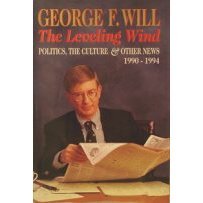
Essays examine the triumphs, misadventures, and foibles of the past four years and criticize the American government's values and its confused political goals
Reviews
Introducing his fifth collection of columns (these from the last four years), syndicated columnist Will (Men at Work) observes that "[t]he culture is news." When writing about books like Katie Roiphe's The Morning After and Shelby Steele's The Content of Our Character, Will tends to extract what buttresses his conservative views without challenging the books' shortcomings. Yet Will is always lucid, more erudite than many of his pundit peers and not always a Republican cheerleader. He nearly gagged at the 1992 Republican National Convention. And while Will scores popular culture and dysfunctional families for the nation's crime scourge, he acknowledges the importance of gun control and drug treatment. Many of his political views, on such subjects as redistricting to achieve minority representation, are predictable; his more interesting work is grounded in his recognition that a careerist Congress and a media-obsessed presidency are not what the Founders intended. Will's best columns surprise, as when he leaves his armchair to visit a Chicago housing project, or when he suggests we place cultural heroes, not politicians, on our currency, a la Europe.
Copyright 1994 Reed Business Information, Inc.
Another 175 pieces of Will's lively, inquiring mind. In his fifth collection (Restoration, 1992, etc.) of short- take commentaries (drawn largely from work published in Newsweek and the Washington Post over the past four years), the syndicated columnist addresses a wealth of consequential issues. To a great extent, however, Will's varied pieces are linked by his concern about the chill, leveling winds of cultural change now whistling through contemporary American society. Informed by a classically conservative sensibility, the author inveighs against the epidemic of illegitimate births, promotion of group (rather than individual) rights, the desensitizing effects of represented violence, the politicization of education, the coarsening of popular entertainment, and the socioeconomic costs of urban decay. Other targets of opportunity include George Bush (who, Will feels, Desert Storm notwithstanding, effectively squandered Ronald Reagan's legacy), Bill Clinton (whose on-again/off-again liberalism earns him comparison with Henry of Navarre, one of history's slicker chameleons), quota systems (whether ethnic, racial, or sexual), interventionist government, Patrick Buchanan, political agendas tarted up to pass as civil rights, the proliferation of victim status, and academe's tenured radicals. If Will finds considerable fault with the latter-day US, he does not ignore the plus side of the ledger altogether (noting at one point that journalists seldom report on all the planes that land safely). By way of example, he celebrates many of the dedicated individuals who work with underclass kids on the mean streets of inner cities that have long since lost their alabaster gleam. The Pulitzer Prizewinning author also has kind words for meritocracy (wherever observed), free trade, traditional family values, Andrew Jackson, Thomas Jefferson (whom he designates the man of the millennium), Harry Truman, and other icons whose libertarian appeal may not be readily apparent to casual students of ideology. Articulately partisan critiques of the volatile and evolving state of the union. -- Copyright ©1994, Kirkus Associates, LP. All rights reserved.
Will may be the best-sounding American political pundit. To prove the point, read him aloud. You can't help putting a tone to every one of his sentences--ironic, earnest, rueful, fervid, and so forth--but a tone that alters pitch and timbre. If you do this exercise with this volume, try its two longer, keynote pieces, a speech on the legacy of Thomas Jefferson and another on how the U.S. got from Jeffersonian yeoman-farmer democracy to Ronald Reagan. Both pieces voice bedrock American conservatism about as intelligently, succinctly, and humanely as anyone could wish. They also, like one after another of the shorter pieces--Will's columns for the Washington Post and Newsweek--tell us things we may have forgotten, such as, in the Reagan speech, that Republicans created big federal government during and after the Civil War, handing it over to Wilsonian Democrats just in time for the income tax's adoption in 1913. In the reprinted columns, Will also often provides estimable reader's advisory service by reporting on his own wide-ranging reading, or he offers fresh insights into public figures both current and historic, or he charms us with a day at the beach with a toddler--his youngest son. Ray Olson
Syndicated columnist, broadcaster, and Pulitzer Prize winner for commentary in 1978, Will is generally regarded as the most erudite spokesman for conservative politics. Here he proves again that political labels are often misleading. In his fifth collection of columns, Will suffers fools badly. He writes of the "emptiness of Bush's politics." Clinton's presidency, he writes, "has become a seamless extension of campaigning, at a cost to the deliberative processes of government." Ross Perot "is a blank book that Americans are judging by its cover." And "government," he contends, "is often imbecilic." There may be no finer writer in the field. Will is at the same time serious and witty, stretching political commentary beyond its normal boundaries. Recommended for all collections.
Chet Hagan, Berks Cty. P.L. Sys., Pa.
Copyright 1994 Reed Business Information, Inc.
"About this title" may belong to another edition of this title.