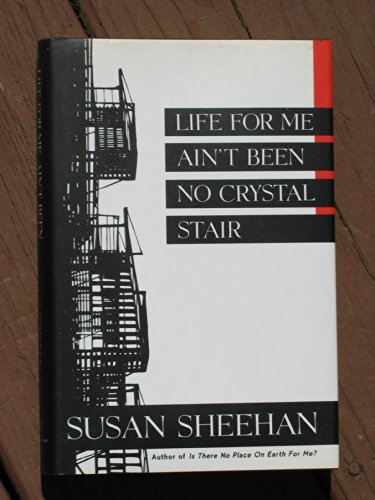
Synopsis
On October 7, 1984, in the seventh month of her pregnancy, Crystal Taylor gave birth to a son. Because Crystal's mother didn't have her own apartment, Crystal had been living temporarily with the baby's father and his parents. But what concerned the hospital case worker was Crystal herself. According to law, fourteen-year-old Crystal was too young to be discharged from the hospital on her own. Both mother and baby would have to be placed in foster care.
There are nearly half a million foster children in the United States. The emotional consequences of foster care - of being moved from one home to another, from foster family to institution and back - on any child are unpredictable. Life For Me Ain't Been No Crystal Stair charts a terrifying legacy of institutional abuse and neglect, shows the damage that has been inflicted on three generations of one inner-city family, and paints a haunting portrait of children growing up without childhood.
Susan Sheehan has written an astonishing and harrowing account of the consequences of a mother's homelessness and drug addiction on her child and grandchild.
Reviews
YA-This Pulitzer Prize winning author has written a poignant and moving tale of foster care in America. Sheehan tells the story of Florence, an African American; her oldest child, Crystal; and Crystal's son, nine-year-old Daquan. Although interviews with Crystal's younger siblings and social workers are incorporated, this narrative is told mainly from Crystal's point of view. At age 14, she gave premature birth to her son. Because she was a minor and her mother was a drug addict, she and her baby were placed in two different foster homes by the state of New York. The author demonstrates how the many moves from one home to another, from one social worker to another, and from one institution to another affected this young woman and her child, and vividly shows the impact of institutional neglect and abuse on dysfunctional families. However, Crystal is a realist and a fighter and successfully takes on the battles of her mother, siblings, and son to improve their lives. This is a compelling tale written in a spare, nonjudgmental style. It's easy to read and informative.
Pat Royal, Crossland High School, Camp Springs, MD
Copyright 1994 Reed Business Information, Inc.
Reprinted from the New Yorker , this searching and graceful book limns a black family's entrenchment in the New York City foster-care system, a system which, says Sheehan, costs taxpayers billions of dollars a year. In 1984, 14-year-old Crystal Taylor and her newborn, Daquan Jr., were placed in foster care because Crystal's mother, Florence, was an itinerant drug addict. Sheehan (author of the Pulitzer Prize-winning Is There No Place on Earth for Me? ) tracks Crystal and Daquan Jr.'s odyssey through foster care and details Crystal's family history. A drug and alcohol abuser since grade school, Crystal witnessed her father's near-death from heroin, was sodomized by an uncle at the age of four, was sexually abused by others and was regularly beaten by Florence, herself an abused child and a product of the foster-care system who eventually placed five other children in foster care as well. Daquan Jr. was fostered by a black middle-class family while Crystal chose to live in a group home where she readily made friends but where she flunked her school courses, was arrested for possession of drugs and for shoplifting, and dated drug dealers, two of whom were murdered. In 1992, Crystal, a mail clerk at an advertising agency, finally accepted responsibility for her son and brought him to live with her in the Brooklyn apartment that she rents.
Copyright 1993 Reed Business Information, Inc.
Sheehan (A Missing Plane, 1986, etc.)--best known for her Pulitzer-winning account of a schizophrenic, Is There No Place on Earth For Me?, (1982)--continues documenting lives on society's margins: in this case, those of a 14-year-old and her premature baby who are separately channeled into the N.Y.C. foster-care system. A slightly different version of the text originally appeared in The New Yorker. Crystal Taylor lived with her 23-year-old boyfriend and his mother in a Bronx housing project--a situation preferable to the emotional and sexual abuse she'd known growing up with her drug- addicted mother, Florence--who, in any case, was homeless. Crystal came to the attention of authorities when she gave birth. Because of her age, her boyfriend was technically guilty of statutory rape, and so the hospital would not discharge her to his residence. The baby was placed with a foster family on Long Island while Crystal went to a diagnostic center--both placements meant to last only until Florence could get on her feet and take her daughter and grandson in. But almost eight years would pass before Crystal herself would be willing and able to make a home for her son. Here, the young woman's odyssey through group homes, special schools, and subsidized, ``independent'' living situations provides an in-depth, frustrating view of an overburdened system, and Crystal herself both maddens and gains sympathy as she works the system with savvy irresponsibility, surviving horrific events with vitality intact. The foster-care experiences of other family members--including those of Florence as a child--reveal people so traumatized that opportunities and a safe place to live are essential but hardly enough. Sheehan offers no solutions here--simply a relentless and dispassionate chronicle of shattered lives and inadequate institutions. -- Copyright ©1993, Kirkus Associates, LP. All rights reserved.
Pulitzer Prize winner Sheehan, author of Is There No Place on Earth for Me? ( LJ 5/15/82), depicts three generations of a New York inner - city family raised in foster care. We meet 14-year-old Crystal Taylor as she and her premature infant son are discharged to separate placements in 1984. Crystal's four younger siblings follow after their mother, Florence, a drug addict, who can no longer care for them. Eight years later, the family is reunited; Crystal has completed her G.E.D., and Florence has finished a treatment program; both are working, though the family is struggling along, buttressed by social service organizations. In Joelle Sanders's similar work, Before Their Time: Four Generations of Teenage Mothers (Harcourt, 1991), a family tells their story in their own words. Recommended for public libraries.
- Lucille Boone, San Jose P.L., Cal.
Copyright 1993 Reed Business Information, Inc.
"About this title" may belong to another edition of this title.