Synopsis
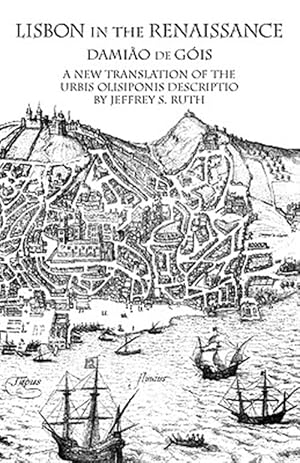
De Gois was a Portuguese humanist, a friend of Erasmus and his circle, and a writer imbued with the classical learning of his day. His Description was written in 1554 at the height of the city's commercial and cultural influence. It places the city in its geographical and historical setting, surveys its topography and environs, and reviews its major architectural attractions. Ruth's introduction places de Góis in the intellectual and historical context of the age, summarizes previous scholarship on the author and his work, and provides useful notes. This edition also includes reproductions of the full 1598 map of Lisbon published by Braun & Hogenberg and a complete English transcription of their numbered key: an indispensable tool for the topography of the Renaissance city. Introduction, notes, bibliography, index, illustrations, maps.
About the Author
Dami'o de G--is was born in 1502 to a family of nobles in Alenquer, a town thirty miles north of Lisbon. G--is' life would span the first three-quarters of the sixteenth century. By the age of nine, Dami'o de G--is had begun his formal education in languages, sciences, music and dance at the court of King Manuel I, in Lisbon. In 1521 King Manuel died, and his successor and son, Jo'o III dispatched the twenty-one year old Dami'o de G--is to Antwerp, where for five years he would exercise the office of secretary at the Casa da India, the principal commercial depot in the entire Portuguese empire. By 1528 G--is merited a diplomatic assignment to England, the first of several missions abroad. In 1529 he traveled to Vilnius (then of Poland) and in 1531 he traveled to Poland and Russia on a mission of diplomacy, passing en route through Schleswig, Denmark. Then, in Wittenberg, G--is attended a sermon by Martin Luther. Later the two dined, joined by another Lutheran leader, Melancthon, with whom G--is would correspond for seven years. G--is enrolled in the University of Louvain (Flanders) in 1532. There he had opportunity to meet the Spaniard Juan Luis Vives, another dedicated Iberian humanist. In 1533 he visited Erasmus in Freiburg, then declined an invitation from King Jo'o to return to Portugal as a teacher of humanistic studies. The following year G--is returned to Freiburg, spending five months as the guest of Erasmus. Upon the advice of Erasmus, G--is settled in Padua for further studies in 1534. In Italy he would establish a long-term friendship with the reform Cardinal Bembo. During his four years in Padua G--is also made the brief acquaintance of Sim'o Rodrigues, a zealous Portuguese cleric who had rose to prominence in Portugal during the 1540s, who denounced G--is as a freethinking heretic first in 1545, and again in 1550. These acts set the stage for the reopening of the case against G--is in 1571, which would lead to his conviction. In 1538 G--is returned from Italy to Louvain, where he married Joana de Hargen. G--is continued his studies, but was taken prisoner by the invading French in 1542, just as he attempted to mediate the crisis. After paying his own ransom, he was handsomely rewarded for his negotiation efforts by the Emperor Charles V. Three years later King Jo'o called G--is back to Portugal. G--is settled near the Castle of S'o Jorge in Lisbon with his wife and three young sons, enjoying an appointment as royal historian at the Torre do Tombo, the national archives. During the next twenty years he produced three important works: the Urbis Olisiponis Descriptio (1554); the Chronicle of the Most Fortunate King Manuel (1566-67); and the Chronicle of Prince Jo'o II (1567). More than anything, G--is' strong links with Protestant reformers during his earlier years abroad led to his final, humiliating downfall. In 1571 the Inquisition once again reviewed the case against G--is, this time calling him before the inquisitorial board. By December of 1572 G--is had been convicted as a heretic and was imprisoned. Old and ill, he was set free sometime later and died under strange circumstances in 1574. The official version of his death depicts him as having fallen into a fireplace late at night at an inn. However, when his remains were transferred in 1941, an analysis revealed a cranial fracture, confirming for some the hypothesis that Dami'o de G--is was murdered.
"About this title" may belong to another edition of this title.