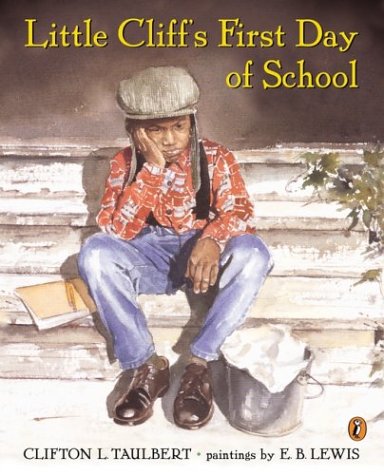
Little Cliff's great-grandmother, Mama Pearl, and his great-grandfather, Poppa Joe, are so excited for him to start first grade. But Little Cliff doesn't want to go to school, especially if it means leaving behind his toys, his home, and his family. When the first day of school comes, Mama Pearl walks Little Cliff to the schoolhouse. As they draw nearer, Little Cliff hears laughter and looks up to see that all of his friends are there. Hmm, maybe school will be fun. . . .
K-Gr 2-In this second story about Little Cliff, an African-American boy growing up in the rural South in the 1950s, it is time for his first day of school. His happy and proud great-grandparents have laid out his special clothes, but Cliff does "not want to start first grade-not one bit." He is so frightened when it's time to leave that he tries hiding under the house-a favorite refuge from the heat of summer. However, determined Mama Pearl coaxes him out and walks him to school herself. As they near the schoolyard, Cliff sees his friends enjoying a ball game and realizes that school isn't just being "quiet, quiet, quiet" and "work, work, work." He can have fun as well. The lengthy text is appropriately flavored by dialect that is readily accessible to young readers: Mama Pearl chides, "Cliff, don't step on my nerves. Now you git them shoes on right now." Lewis's large watercolor paintings of the boy with downcast eyes, bowed head, and slumped shoulders speak volumes about his apprehensions. The country schoolhouse looks run-down and uninviting until it is surrounded by energetic youngsters. Children will recognize in Cliff's reactions their own first-day jitters and will be comforted by the last scene in which a laughing-crying Mama Pearl hugs him and says, "I am just so happy we made it to school on our first day."-Marianne Saccardi, Norwalk Community College, CT
Copyright 2001 Cahners Business Information, Inc.