Synopsis
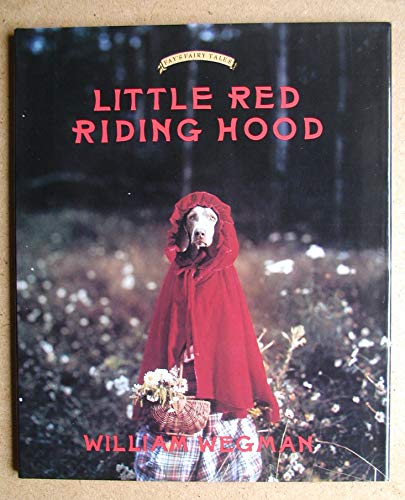
Little Red Riding Hood is threatened by a wolf when she delivers some muffins to her ailing grandmother, in a photographic reinterpretation of the classic fairy tale in which dogs play the characters
Reviews
Grade 2-3-The traditional folktale has been overwritten and laden with unnecessary details. The sole purpose for this expanded version seems to be to create more photo opportunities for Wegman's familiar Weimaraners. Frankly, the dogs are charming when dressed in hooded red capes, nightgowns, and plaid flannel shirts, but a problem arises when the wolf masquerades as grandma, since they look identical. Children are likely to have trouble understanding that the two grandmothers are not the same person/dog. Also certain plot details have been changed. Instead of the woodsman cutting open the wolf, "The sudden shock of seeing the armed woodsman made him [the wolf] quite nauseous" and he throws up grandma and Red Riding Hood. This may be an attempt to ameliorate the violence of the story, but it appears a bit hypocritical since in a previous photo the wolf's teeth are streaked with blood after eating the pair. Older children and adults may enjoy this romp, but stick to the classic versions for young children.
Karen K. Radtke, Milwaukee Public Library
Copyright 1994 Reed Business Information, Inc.
Arriving on the tails of Cinderella , the second of Fay's Fairy Tales continues to feature photographer Wegman's famously photogenic weimaraners, but, unlike the previous book, reflects a predominantly adult sensibility. Wegman experiments more here, trying different camera angles, shooting his dressed-up dogs outdoors as well as inside, and achieving a depth of field that recalls the tableaux of old Viewmaster toys. Campiness is the order of the day: for example, an obviously fake stag's head intrudes into one picture of a caped Red Riding Hood carrying goodies through the forest; " 'Look, a deer. It has antlers. It must be a stag. Hello, stag,' she whispered to herself so as not to startle it" reads the facing text. But the irony reaches its apogee when the wolf pretends to Red Riding Hood that it is her grandmother--the dog-as-wolf-as-grandmother is a virtual twin of the dog-as-grandmother, so that the "what big ears you have!" sequence becomes tongue-in-cheek. A few jolting images--of the "wolf" with bloody fangs presiding over a limp raccoon stole, or of it snapping ferociously at Red Riding Hood--may also deter the youngest readers even as their elders are entertained. All ages.
Copyright 1993 Reed Business Information, Inc.
Ages 7-9. Surely everyone must know that Wegman is the man who takes pictures of his weimaraners, often dressing them up in clothing of one sort or another. Lately, they've been wearing fairy- tale garb, for example, in Cinderella. Some people love the concept, others hate it, and only you know whether these books have a place in your library. However, no matter what you think of the pictures, there is also a story to deal with here, and that's where even the least pure of purists may have a quibble. With Little Red Riding Hood you usually get either the tame ending (Grandma's hiding in the closet, and the hunter saves Red Riding Hood) or the more traditional, grizzly ending (Little Red Riding Hood and Grandma get eaten, but the hunter slices the wolf open and the two jump out, unharmed). Here we get the Wegman version: the wolf looks at the hunter, gets dizzy, throws up, and vomits out Red Riding Hood and her grandmother, none the worse for wear. There are also a few problems with the pictures. Kids may question why the wolf is just an undressed dog (and may blanch at the dead raccoon at his feet in one shot), while adults will notice that the one two-page spread is the same shot with the negative reversed. An offering for those who don't mind their Red Riding Hood with eyes and teeth as big as Granny's Ilene Cooper
"About this title" may belong to another edition of this title.