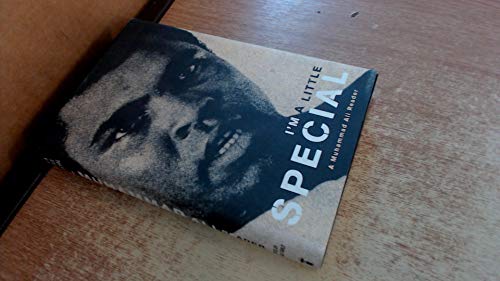
Muhammad Ali is still one of the best known figures in the world--a sports man, but seen by his fans and admirers as more--someone who ranks as one of the heroes of his generation.
Those who saw him fight talk of Ali with a dreamy look in their eyes, as if he was like nothing or nobody they had ever seen grace the canvas of the boxing ring before or after.
I'm A Little Special follows Ali's boxing career and life from his days as Cassius Clay in the 1960s to the slowed frame that we have seen in his later days as a shadow of his former self.
Magazine and newspaper articles of the time tell the story of a supreme boxer and talker, a world champion who believed--no, knew--that he was in his rightful place at the very top of the sport.
A variety of articles--news stories and features, observations and interviews--are threaded together to form a unique reading on boxing's most famous ambassador.
The book tells the story of a true superstar, but shows the slowing down of Ali through boxing-induced Parkinson's disease.
Articles are introduced chronologically and the tome includes writings from some of the world's most respected journalists and publications.
The differing styles of writing and the carefully selected and edited articles add a spice to the book and give the excellent collection a changing pace.
Gerald Early has shown through his choices--out of literally thousands of pieces written on the great showman--his respect and admiration of the man, not just the boxer, that is Muhammad Ali. --Andrea Thursday
There is no mistaking the marvels of the
Ali Reader. It begins with the cover, which leaves you wordless--literally; there is nothing on it except the face of The Greatest linking you in his gaze, toying with your curiosity, and inviting you to step inside.
And what's inside is a knockout collection of 30 essays (and a poem from Nobelist Wole Soyinka) on the most remarkable sportsman of the 20th century, written by a stable of some of the most powerful contemporary literary heavyweights ever assembled in one ring: A.J. Liebling, Tom Wolfe, George Plimpton, LeRoi Jones, Murray Kempton, and Irwin Shaw spar with the Ali of the '60s and his metamorphosis from Cassius Clay; Norman Mailer, Pete Hamill, Gary Wills, Hunter Thompson, and Ishmael Reed pick up the saga in the '70s; and Jose Torres, Joyce Carol Oates, and Gay Talese bring the myth into the present.
From his entrance onto the world stage in 1960, Ali exuded a fascinating mixture of personality and skill, which he combined with an ability to mesmerize, charm, infuriate, and cajole. He has always been a writer's dream subject. His inherent poetry seemed to demand nothing less than worthy efforts from the legion of scribes who tried to corner him in prose; Ali possessed the goods that bring writers up to his level.
There are several surprises here, particularly in the early rounds, in which both former heavyweight champion Floyd Paterson (humiliatingly taunted by Ali in and out of the ring) and Jackie Robinson defend his embrace of the Black Muslims. Hamill writes poignantly about what Ali's individualism and his principles cost him in the eyes of the white public: "He had, quite simply, broken too many rules on the way to becoming a man." Thompson provides a dizzying chronicle of "the brown Jay Gatsby." Mailer writes searingly on ego and the body. And Oates, one of the most insightful of all observers of the Sweet Science, sums up his "Parkinsonian" present of muscular shakes and slurred speech with a single, thrilling line: "Who is to presume to feel sorry for one who will not feel sorry for himself?" Ali's own marvelous voice rings clear in a long Playboy interview as well as a shorter, but no less substantial, Q&A for Sport magazine conducted by former light heavyweight titlist Torres.
Though Ali is always on center stage, you don't need to like boxing--or even The Greatest--to be held in the spell of the Reader's literary wallop. The power of its pens should rivet your interest the way Ali himself used to hold ringsiders spellbound. --Jeff Silverman