
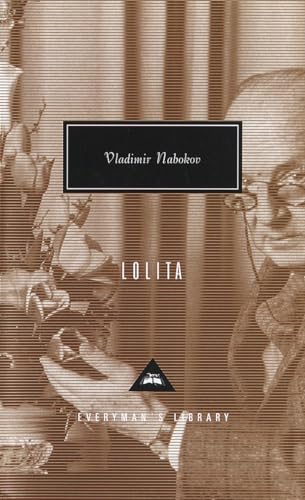
Lolita: Introduction by Martin Amis (Everyman's Library Contemporary Classics Series)
Nabokov, Vladimir
ISBN 10: 0679410430 ISBN 13: 9780679410430
Published by Everyman's Library, 1993
Used
Hardcover
From
World of Books (was SecondSale), Montgomery, IL, U.S.A.
Seller rating 5 out of 5 stars

AbeBooks Seller since December 20, 2007
This specific item is no longer available.
About this Item
Description:
Item in very good condition! Textbooks may not include supplemental items i.e. CDs, access codes etc. Seller Inventory # 00102427691
Synopsis:
Nabokov's wise, ironic, elegant masterpiece owes its stature as a classic not to the controversy its subject matter aroused but to its author's use of that material to tell a love story almost shocking in its beauty and tenderness. With an introduction by Martin Amis.
When it was published in 1955, Lolita immediately became a cause célèbre because of the freedom and sophistication with which it handled the unusual erotic predilections of its protagonist. Awe and exhilaration–along with heartbreak and mordant wit–abound in this account of the aging Humbert Humbert's obsessive, devouring, and doomed passion for the nymphet Dolores Haze.
Lolita is also the story of a hypercivilized European colliding with the cheerful barbarism of postwar America, but most of all, it is a meditation on love–love as outrage and hallucination, madness and transformation.
Everyman's Library pursues the highest production standards, printing on acid-free cream-colored paper, with full-cloth cases with two-color foil stamping, decorative endpapers, silk ribbon markers, European-style half-round spines, and a full-color illustrated jacket. Contemporary Classics include an introduction, a select bibliography, and a chronology of the author's life and times.
About the Author:
VLADIMIR NABOKOV was born on April 23, 1899, in St. Petersburg, Russia. The Nabokovs were known for their high culture and commitment to public service, and the elder Nabokov was an outspoken opponent of antisemitism and one of the leaders of the opposition party, the Kadets. In 1919, following the Bolshevik revolution, he took his family into exile. Four years later he was shot and killed at a political rally in Berlin while trying to shield the speaker from right-wing assassins.
The Nabokov household was trilingual, and as a child Nabokov was already reading Wells, Poe, Browning, Keats, Flaubert, Verlaine, Rimbaud, Tolstoy, and Chekhov, alongside the popular entertainments of Sir Arthur Conan Doyle and Jules Verne. As a young man, he studied Slavic and romance languages at Trinity College, Cambridge, taking his honors degree in 1922. For the next eighteen years he lived in Berlin and Paris, writing prolifically in Russian under the pseudonym Sirin and supporting himself through translations, lessons in English and tennis, and by composing the first crossword puzzles in Russian. In 1925 he married Vera Slonim, with whom he had one child, a son, Dmitri.
Having already fled Russia and Germany, Nabokov became a refugee once more in 1940, when he was forced to leave France for the United States. There he taught at Wellesley, Harvard, and Cornell. He also gave up writing in Russian and began composing fiction in English. In his afterword to Lolita he claimed: "My private tragedy, which cannot, and indeed should not, be anybody's concern, is that I had to abandon my natural idiom, my untrammeled, rich, and infinitely docile Russian tongue for a second-rate brand of English, devoid of any of those apparatuses–the baffling mirror, the black velvet backdrop, the implied associations and traditions–which the native illusionist, frac-tails flying, can magically use to transcend the heritage in his own way." [p. 317] Yet Nabokov's American period saw the creation of what are arguably his greatest works, Bend Sinister (1947), Lolita (1955), Pnin (1957), and Pale Fire (1962), as well as the translation of his earlier Russian novels into English. He also undertook English translations of works by Lermontov and Pushkin and wrote several books of criticism. Vladimir Nabokov died in Montreux, Switzerland, in 1977.
"About this title" may belong to another edition of this title.
Bibliographic Details
Title: Lolita: Introduction by Martin Amis (...
Publisher: Everyman's Library
Publication Date: 1993
Binding: Hardcover
Condition: Very Good
Edition: 5th or later Edition