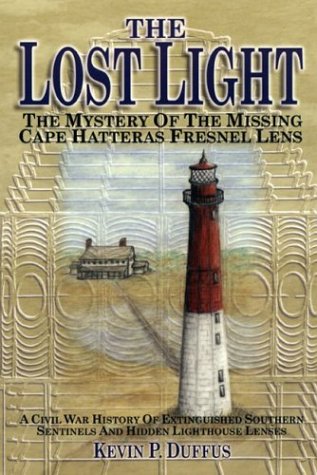
In September 2002, after 3 years of research, Raleigh author and filmmaker, Kevin Duffus, solved the long-standing mystery of the missing, first-order Fresnel lens from the 1803 Cape Hatteras Lighthouse. The first-order optic was removed from the top of the first Hatteras tower in 1861, in a desperate act to prevent the beacon from aiding the Union Navy’s blockade. In its wake, the Hatteras lens left a trail of destruction, defiance and recrimination—careers were lost, towns were threatened, and the steamboat that transported the lighthouse contraband was captured and sunk. The apparatus, produced in France of more than 1,000 crown-crystal prisms and one of the earliest commissioned for a U.S. lighthouse, was eventually hidden in "a good storehouse," in Granville County, NC, 200 miles from the Cape.
So began an intriguing mystery that endured for 140 years—what became of the 6,000-pound, 12-foot tall, bronze and crystal Fresnel lens from the original Cape Hatteras Lighthouse, hidden during the Civil War? Considered by lighthouse historians to be the "holy grail" of American lighthouses, the storied apparatus vanished into obscurity, a mystery made of myths, urban legends and a sea of faded and fire-damaged documents. According to Lighthouse Digest, the whereabouts of the Cape Hatteras lens had remained "one of the great-unsolved mysteries of American lighthouse history."
Kevin Duffus tells an intriguing and inspiring story of perseverance, passion, imagination and luck during his three-year pursuit and research for the long lost Henry-Lepaute first-order Fresnel lens from the 1803 Cape Hatteras Lighthouse. But Duffus discovered more than the storied Hatteras lens—he compiled a staggering volume of research that for the first time, accurately portrays the desperate efforts of Confederate officials to darken the southern coastline and to hamper Lincoln’s blockade of southern ports. His new research proves that contrary to previous published histories, Southern lighthouse lenses were not vandalized or "shot out of the tops of lighthouses by retreating Confederate soldiers," but that most were carefully and professionally dismantled, gently packed and secretly transported to secure locations. Throughout the war, Federal troops searched customs houses, warehouses and military depots in search of North Carolina’s missing two-dozen lighthouse lenses without success.
Kevin Duffus is also a documentary filmmaker specializing in North Carolina maritime history. Some of his award-winning documentaries include: The Graveyard of the Atlantic-Four Hundred Years of Shipwrecks, Mysteries and Heroic Rescues; The Cape Hatteras Light-America's Greatest Sentinel; Move of the Century, documenting the remarkable relocation of the Cape Hatteras lighthouse; and War Zone-World War Two Off North Carolina's Outer Banks, which examines one of the greatest maritime disasters in history and the American nation's worst-ever defeat at sea.
In 1989, Duffus traveled around the world to document how Habitat for Humanity built houses and friendships in other countries. Duffus' television career began in 1972 and by the age of 23 he was directing the highest-rated locally -produced news program in the nation. In the 1980s, as Exectutive Producer of Raleigh station WRAL-TV, Duffus produced programs in England about Walter Raleigh's voyages to the New World, and in East Africa about drought and famine. In 1981 Duffus co-produced a national documentary on neighborhood efforts to fight crime and shared a George Foster Peabody award for excellence in journalism. Duffus' other honors include the World Hunger Media Award, the Edward R. Murrow award and the National Education Association award.
Kevin serves as Chairman of the Board of Directors of the Graveyard of the Atlantic Museum in Hatteras, NC.