
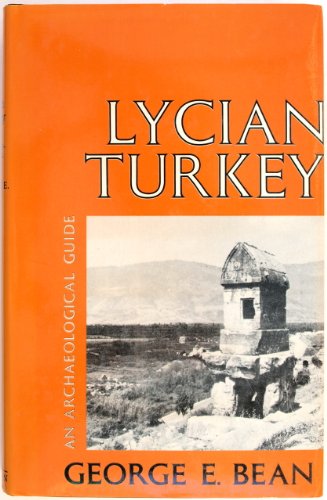
Lycian Turkey: An Archaeological Guide
Bean, George E.
ISBN 10: 0510032052 ISBN 13: 9780510032050
Published by Ernest Benn, London, 1978
Used
Hardcover
From
Montana Book Company, Fond du Lac, WI, U.S.A.
Seller rating 5 out of 5 stars

AbeBooks Seller since June 6, 2002
This specific item is no longer available.
About this Item
Description:
197 pp. Tightly bound. Corners not bumped. Text is free of markings. No ownership markings. Very good dust jacket. The jacket has one 2" closed edge tear. This copy has an orange dust jacket with white and black type face. This copy is smyth sewn. Smyth sewing is a method of bookbinding where groups of folded pages (referred to as signatures) are stitched together using binder thread. Each folded signature is sewn together individually with multiple stitches and then joined with other signatures to create the complete book block. This is the traditional and best method of bookbinding. Seller Inventory # 093448
Synopsis:
Ernest Benn [Published Date: 1978]. Hardcover, 197 pages plus 28 unnumbered pages of plates. First edition. Contents include: Foreword; List of Plates; List of Illustrations in Text; Glossary; Historical; The West Coast; Telmessus; Excursions from Fethiye, Cadyanda, Lydae, Lissa; Xanthus, The Letoum; The Xanthus Valley I : Tlos, Arsadda Araxa; The Xanthus Valley II : Pinara Sidyma; Patara; Central Lycia I : Phellus and Antiphellus; Central Lycia II : Aperlae, Apollonina, Isinda; Central Lycia III : Candyba, Cyaneae, Trysa; Central Lycia IV : Kekova Teimiussa, Simena, Tyberissus; Myra, Sura; Arneae, Arycanda; eastern Lycia : Limyra, Rhodiapolis, Gagae, Phaselis; Northern. Lycia : Podalia, Choma; The Cibyratis : Cibyra, Bubon, Balbura, Oenoanda; Appendix : The Xanthian Stele; Bibliography; References; Index. [From Foreword] The present volume fills the gap left by my three previous books . . . the four together now cover the whole of the south-west corner of Turkey from Pergamum to Alanya. Lycia is still the least accessible and least visited part of this region, even though there has been a great change in recent years. When I first visited the Xanthus valley in 1946, the country was really remote. Tractors were unknown, and every man simply grew on his own patch of land enough to feed his family through the year; no one bothered to market his produce in Fethiye; the two-days trek each way with a donkey was not worthwhile. . . It is not so now; bus and lorry transport and modern agricultural machinery have produced a transformation. . . . Looking back over twenty-five years of exploration in Anatolia, I remember with most pleasure my journeys in Lycia. They were certainly strenuous, even to the point of exhaustion often enough, but the country has, at least for me, a fascination not equalled elsewhere. The scenery is impressive, often spectacular, and seen by moonlight is out of this world; and the ancient monuments, especially of course the tombs, have a quality of their own. Since Sir Charles Fellows removed the Xanthian marbles to the British Museum no excavation was done in Lycia for a century and a quarter, and most of the sites are still untouched save for illicit digging by the villagers. In 1962 the French began a thoroughgoing excavation of Xanthus and the Letoum which is still in progress, and of late work has also been done at Myra, Limyra, and Arycanda. So, although it is now seven years since I left Turkey, not much change is likely to have occurred m the meantime. The descriptions of the sites in this book are all at first hand, with the exception of Arneae, which I have never been able to visit. . . Here again I have written primarily for the traveller, presupposing an interest in antiquities rather than any special knowledge, and have not hitherto included references for the individual statements. It has, however, been represented to me that scholars who may on occasion find the books useful would welcome such references, and I have this time included a list of passages from the ancient authorities. For modern discussions the Bibliography must suffice.
"About this title" may belong to another edition of this title.
Bibliographic Details
Title: Lycian Turkey: An Archaeological Guide
Publisher: Ernest Benn, London
Publication Date: 1978
Binding: Hardcover
Condition: Very Good
Dust Jacket Condition: Very Good Dust Jacket