Synopsis
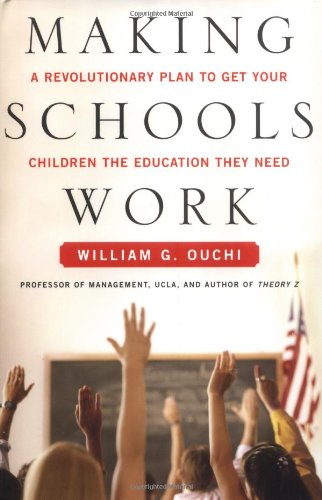
Based on a comprehensive study of more than twho hundred schools, a plan for national classroom reform recommends a revolutionary management system though which principals, rather than school boards, are given control over budgets and personnel. 50,000 first printing.
Reviews
Since the 1983 publication of A Nation at Risk, readers have been deluged with proposals for school reform. This work by UCLA management school "corporate renewal" professor Ouchi takes its place among them. Ouchi bases his theory on sound principles derived from his research into a variety of successful schools. Educational management systems should be entrepreneurial rather than bureaucratic, he says. Give principals real control over their budgets, empower parents as genuine participants in school decisions, and student achievement will soar, even in communities beset by poverty and high immigration rates, two usual indicators of school failure. Any useful management book must reduce complex issues to bullets, and this one is no exception: Ouchi's arguments, encapsulated in his "Seven Keys to Success," claim to "revolutionize" schools and lead to vastly improved student academic achievement. "Revolutionary" may be too strong a word here, and in fact, some of the pedagogical practices Ouchi highlights are dubiously retrograde (e.g., third graders "reciting the days of the week, the months of the year, and the number of days in a week, month, and year"). However, Ouchi doesn't prescribe any of these rituals; he merely advocates for the empowerment of school communities to choose what's best for their particular students. Of interest to school leaders and policy makers, the book also has a section devoted to what parents and community members can do to improve not just their school but their school district, where fundamental change is essential.
Copyright 2003 Reed Business Information, Inc.
Ouchi, a professor of management, studied 223 schools in nine school systems to develop a theory on how to manage schools successfully. He focuses on public and Catholic schools in the three largest school districts (New York, Los Angeles, and Chicago) and compares them with three successful school districts (Edmonton, Canada; Seattle; and Houston). Ouchi boils down the successful elements to seven factors: entrepreneurial principals, budgetary control, accountability for performance and budget, delegating authority, focus on student achievement, community of learners, and real choice for families. Ouchi devotes an entire chapter to each key to success, drawing on his observations at the successful schools and comparisons with the nation's largest school systems. He concludes with a guide for parents to evaluate their children's school and practical recommendations on how parents and educators can adopt the key elements of success to their own schools and districts. This detailed and compelling look at effective school management will appeal to parents and educators alike. Vanessa Bush
Copyright © American Library Association. All rights reserved
"About this title" may belong to another edition of this title.