
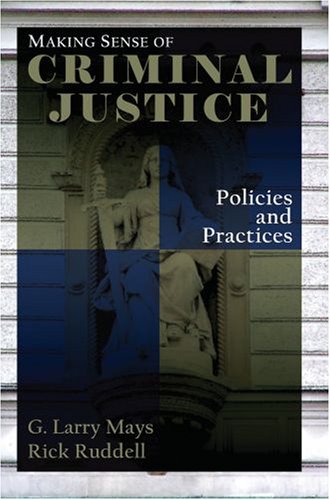
Making Sense of Criminal Justice: Policies and Practices
G. Larry Mays; Rick Ruddell
ISBN 10: 019533244X ISBN 13: 9780195332445
Published by Oxford University Press, 2007
Used
Paperback
From
ThriftBooks-Reno, Reno, NV, U.S.A.
Seller rating 5 out of 5 stars

AbeBooks Seller since May 25, 2012
This specific item is no longer available.
About this Item
Description:
May have limited writing in cover pages. Pages are unmarked. ~ ThriftBooks: Read More, Spend Less. Seller Inventory # G019533244XI4N00
Synopsis:
As they learn about the criminal justice system, students often hear that "nothing works." Enter Making Sense of Criminal Justice--an innovative and insightful textbook that meets the needs of both criminal justice policy courses and undergraduate capstone courses (sometimes called "senior seminars"). Beginning with an outline of the crime control and due process models, G. Larry Mays and Rick Ruddell have organized the book around the three major components of the criminal justice system (police, courts, and corrections). This topical, issues-oriented approach encourages students to think critically about major dilemmas faced by participants in the system, from issues of race and gender to the use of the death penalty.
Working from a balanced viewpoint, the authors argue that criminal justice is inherently a political process; they examine strategies that work, those that do not work, and those that represent a gray area between the two extremes. Rather than providing students with "the answers," Mays and Ruddell challenge them to think critically about how we deal with situations--such as the use of force by the police--and offer a framework for lively classroom discussions and debates.
End-of-chapter key terms, critical-thinking review questions, and recommended readings enhance students' understanding of the material and aid in test preparation.
About the Author: G. Larry Mays is at New Mexico State University. Rick Ruddell is at the California State University, Chico.
"About this title" may belong to another edition of this title.
Bibliographic Details
Title: Making Sense of Criminal Justice: Policies ...
Publisher: Oxford University Press
Publication Date: 2007
Binding: Paperback
Condition: Very Good
Dust Jacket Condition: No Jacket