Synopsis
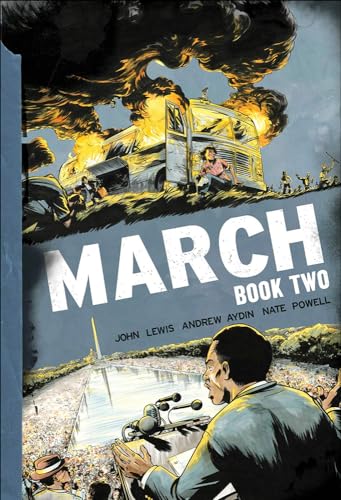
Congressman John Lewis, an American icon and one of the key figures of the civil rights movement, continues his award-winning graphic novel trilogy with co-writer Andrew Aydin and artist Nate Powell, inspired by a 1950s comic book that helped prepare his own generation to join the struggle. Now, March brings the lessons of history to vivid life for a new generation, urgently relevant for today's world. After the success of the Nashville sit-in campaign, John Lewis is more committed than ever to changing the world through nonviolence - but as he and his fellow Freedom Riders board a bus into the vicious heart of the deep south, they will be tested like never before. Faced with beatings, police brutality, imprisonment, arson, and even murder, the movement's young activists place their lives on the line while internal conflicts threaten to tear them apart.
But their courage will attract the notice of powerful allies, from Martin Luther King, Jr. to Attorney General Robert F. Kennedy... and once Lewis is elected chairman of the Student Nonviolent Coordinating Committee, this 23-year-old will be thrust into the national spotlight, becoming one of the "Big Six" leaders of the civil rights movement and a central figure in the landmark 1963 March on Washington for Jobs and Freedom.
New York Times Bestseller
One of YALSA's Great Graphic Novels for Teens
2016 Eisner Award for Best Reality-Based Work - Winner
2016 Harvey Award for Best Biographical, Historical, or Journalistic Presentation - Winner
2016 Harvey Award for Best Graphic Album Original - Winner
2016 Street Literature Book Award Medal for Best Graphic Novel - Winner
2016 Denver Independent Comic & Art Expo Award for Best Work - Mid/Large Press - Winner
Reviews
Gr 9 Up—Gr 8 Up-In this second volume, representative Lewis continues describing his experiences with the civil rights movement. As in the first book, Lewis attends Barack Obama's inauguration, flashing back to his life as a young man taking part in the fight that would make it possible for America to eventually elect its first black president. Lewis lays out his involvement with sit-ins and the freedom rides, as well as becoming chairman of the Student Nonviolent Coordinating Committee and speaking at the March on Washington in 1963, where he urged the crowd to "complete the revolution." Graphic in every sense of the word, this memoir puts a human face on a struggle that many students will primarily know from textbooks. Lewis makes it clear that the movement was far from a uniform entity, with disagreements cropping up, some small, such as differing opinions about the wording in speeches, others more serious, including whether to respond to resistance passively or with violence. Visually stunning, the black-and-white illustrations convey the emotions of this turbulent time, from Lewis's fear and pain while in prison to Governor George Wallace's sneering indifference during his "Segregation forever" speech. Powell's use of light and dark is masterly, and the contrast between the joy of Obama's inauguration and the obstacles faced back in the 1960s is effective. This insider's view of the civil rights movement should be required reading for young and old; not to be missed.—Mahnaz Dar, School Library Journal
"About this title" may belong to another edition of this title.