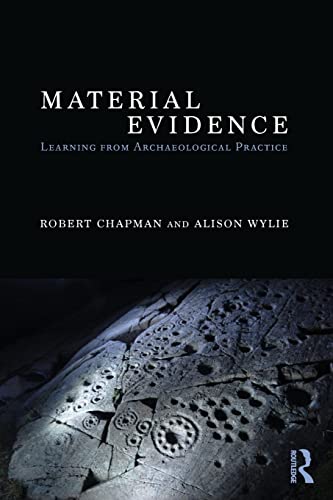
How do archaeologists make effective use of physical traces and material culture as repositories of evidence?
Material Evidence takes a resolutely case-based approach to this question, exploring instances of exemplary practice, key challenges, instructive failures, and innovative developments in the use of archaeological data as evidence. The goal is to bring to the surface the wisdom of practice, teasing out norms of archaeological reasoning from evidence.
Archaeologists make compelling use of an enormously diverse range of material evidence, from garbage dumps to monuments, from finely crafted artifacts rich with cultural significance to the detritus of everyday life and the inadvertent transformation of landscapes over the long term. Each contributor to Material Evidence identifies a particular type of evidence with which they grapple and considers, with reference to concrete examples, how archaeologists construct evidential claims, critically assess them, and bring them to bear on pivotal questions about the cultural past.
Historians, cultural anthropologists, philosophers, and science studies scholars are increasingly interested in working with material things as objects of inquiry and as evidence – and they acknowledge on all sides just how challenging this is. One of the central messages of the book is that close analysis of archaeological best practice can yield constructive guidelines for practice that have much to offer archaeologists and those in related fields.
Bob Chapman is Emeritus Professor of Archaeology at the University of Reading, UK. His research focuses on archaeological theory, Mediterranean later prehistory, the development of human inequality and the means by which this can be studied with archaeological data. He has pursued these interests in fieldwork projects in southeast Spain and the Balearic Islands, as well as in books such as The Archaeology of Death (1981), Emerging Complexity (1990) and Archaeologies of Complexity (2003). In recent years his research has turned increasingly to the use of historical materialism in archaeological interpretation, especially in relation to inequality and human exploitation. Running through this research activity has been a strong concern for the nature of archaeological interpretation, working with the complementary evidence of how people lived (e.g. what they produced, exchanged and consumed, centred on settlement evidence) and how they were treated in death (e.g. their disposal, centred on burial evidence).
Alison Wylie is Professor of Philosophy and Anthropology at the University of Washington, and of Philosophy at Durham University. She is a philosopher of the social and historical sciences who works on questions about objectivity, evidence, and research ethics raised by archaeological practice and by feminist research in the social sciences. Her longstanding interest in evidential reasoning is represented by Thinking from Things (2002) and by contributions to Evidence, Inference and Enquiry (Dawid, Twining and Vasilaki, 2011), How Well do 'Facts' Travel? (Morgan, 2010), and Agnatology (Proctor and Schiebinger, 2008). In recent work she focuses on the role of contextual values in science and on how research can be improved by internal diversity and by collaborations that extend beyond the research community. These interests are reflected in Value-free Science? (co-edited with Kincaid and Dupré, 2007) and Epistemic Diversity and Dissent (edited for Episteme 2006), as well as in essays on stewardship and feminist standpoint theory.