Synopsis
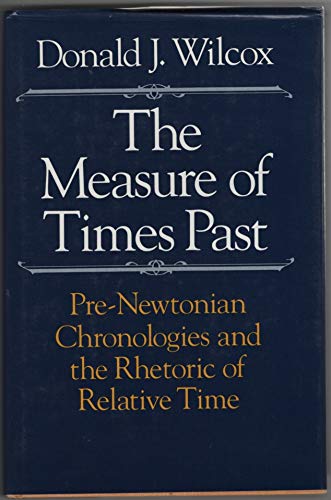
In this extraordinary work, Donald J. Wilcox seeks to discover an approach to narrative and history consistent with the discontinuous, relative time of the twentieth century. He shows how our B.C./A.D. system, intimately connected to Newtonian concepts of continuous, objective, and absolute time, has affected our conception and experience of the past. He demonstrates absolute time's centrality to modern historical methodologies and the problems it has created in the selection and interpretation of facts. Inspired by contemporary fiction and Einsteinian concepts of relativity, he concludes his analysis with a comparison of our system with earlier, pre-Newtonian time schemes to create a radical new critique of historical objectivity.
Reviews
Wilcox's useful, though highly specialized book, is a well-documented account of the various chronologies in use since classical antiquity. The current year is "1987," not by an a priori standard but according to a measure worked out by Domenicus Petavius in the 17th century. Petavius saw time as linear, thus differing from Greek and Roman historians, who saw it as plural. Wilcox maintains that 20th-century physics, literature, and art show that the absolute view of time is being abandoned. The author's knowledge of the history of chronology is impressive. Not so his philosophical observations, which contain a number of errors. Yet readers who wisely ignore his efforts to wax metaphysical will find much of value in this work. David Gordon, Social Philosophy and Policy Center, Bowling Green State University, Ohio
Copyright 1987 Reed Business Information, Inc.
"About this title" may belong to another edition of this title.