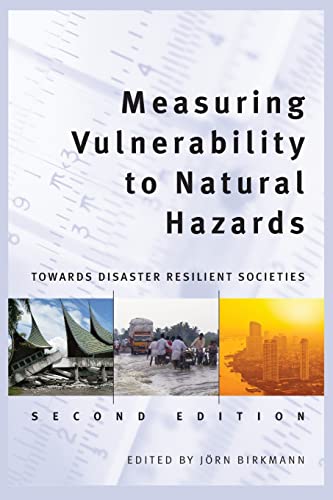
When societies attempt to plan for or rebuild in the aftermath of catastrophic natural disasters, organizers use terms such as "climate change adaptation," "building esilience," and "vulnerability and risk reduction." But what do these terms actually mean in the way of achievable goals? And how can a society accurately evaluate progress toward those goals? Measuring Vulnerability to Natural Hazards addresses these questions.
The world is still reeling from several disasters of a magnitude rarely seen: the cascading disaster in Japan, the earthquake in Haiti, floods in Pakistan and Australia. These catastrophes underline the fact that many communities and regions are still vulnerable to extreme events and natural hazards. Additionally, creeping climate-related changes such as rising sea levels will seriously affect livelihoods in many areas. It's been estimated that more than 20 percent of the population in developing countries could face the risks of various hazards such as toxic buildups of salt in the soil, flooding, and coastal storm surges. The dynamic and complex interaction between vulnerable communities and natural hazards, climate-related and otherwise, probably increases the risk of crises and disasters in the future.
Measuring Vulnerability to Natural Hazards combines practical examples from Africa, Asia, the Americas, and Europe with theoretical and conceptual frameworks for anticipating, preparing for, and responding to disasters. It is essential for all those interested in improving risk reduction and adaptation strategies to extreme events as well as gradual changes related to climate change and natural hazards.
Jörn Birkmann is academic officer and head of the Vulnerability Assessment, Risk Management and Adaptive Planning Section at the United Nations University Institute for Environment and Human Security (UNU-EHS), and visiting adjunct professor at the department of geography, University of Bonn. He is also lead author for the IPCC Special Report Managing the Risk of Extreme Events and Disasters to Advance Climate Change Adaptation and lead author for the IPCC Fifth Assessment Report. He chairs an Expert Working Group on Measuring Vulnerability and is a member of the Academy of Spatial Planning in Germany.