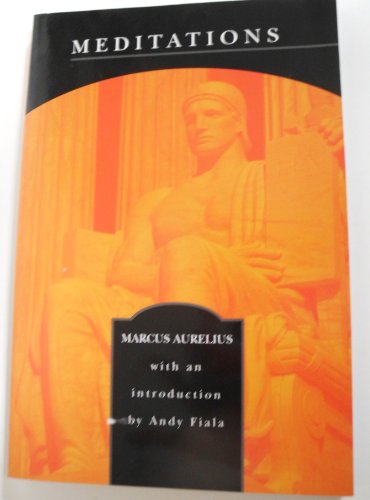
Synopsis
A private book of reflections that is written over a series of years in far-flung places as the author led the Romans in military campaigns, quashed revolts, and dealt with the other tribulations of governing the Empire. Best described as a spiritual journal, it contains a record of the author's philosophical exercises.
Review
One measure, perhaps, of a book's worth, is its intergenerational pliancy: do new readers acquire it and interpret it afresh down through the ages? The Meditations of Marcus Aurelius, translated and introduced by Gregory Hays, by that standard, is very worthwhile, indeed. Hays suggests that its most recent incarnation--as a self-help book--is not only valid, but may be close to the author's intent. The book, which Hays calls, fondly, a "haphazard set of notes," is indicative of the role of philosophy among the ancients in that it is "expected to provide a 'design for living.'" And it does, both aphoristically ("Think of yourself as dead. You have lived your life. Now take what's left and live it properly.") and rhetorically ("What is it in ourselves that we should prize?"). Whether these, and other entries ("Enough of this wretched, whining monkey life.") sound life-changing or like entries in a teenager's diary is up to the individual reader, as it should be. Hays's introduction, which sketches the life of Marcus Aurelius (emperor of Rome A.D. 161-180) as well as the basic tenets of stoicism, is accessible and jaunty. --H. O'Billovich
"About this title" may belong to another edition of this title.