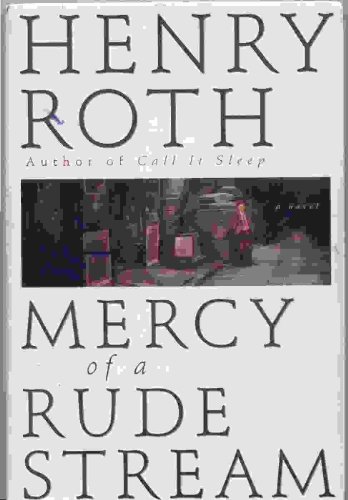
Synopsis
Ira Stigman, an immigrant boy, suffers a cruel Americanization process from 1914 through 1921 in a novel that deals with themes of Prohibition, anti-Semitism, racism, and the violence of sexuality. By the author of Call It Sleep. 50,000 first printing.
Reviews
Henry Roth's literary reputation would be secure on the strength of his remarkable first novel, Call It Sleep , published in 1934 and but largely unknown until it appeared in paperback in 1964 and became an instant classic. Roth's silence in the intervening years has been broken only by a collection of his shorter pieces, Shifting Landscape . This novel, then, is a signal event, especially since its protagonist, Ira Stigman, is clearly the same young boy who served as Roth's fictional alter ego in the first book, and since it begins roughly where the earlier novel ended--in the teeming immigrant slums of New York City during the first decades of the 20th century, a time and place that Roth captures with pungent language and palpable immediacy. Roth's long struggle with this material is reflected in first-person passages interpolated into the narrative in which the now elderly Ira addresses his word processor (called Ecclesias), ruminates about the difficulties that stilled his pen, and makes references to an earlier version of this work, which he is rewriting as he goes along. He laments the crisis of identity, the "loss of affirmation" and the self-loathing that crippled his imaginative powers, events that he touches on in the third-person narrative. Again we encounter the violent, penny-pinching father, the supportive mother, the loutish relatives. Ira's memories range over family strife, his school days, the dangers of the street, the disruption of WW I, and they end--somewhat abruptly--after the book's best extended scenes, set in a fancy grocery store where the adolescent Ira works after high school. This is the most forceful part of the book, a sustained, controlled piece of writing that masterfully evokes the temper of the times--the advent of Prohibition, the casual bigotry and racism of blue-collar workers and veterans--in the process of limning a group of memorable character portraits. Since this is to be the first volume of six, the story ends ambiguously, after repeatedly hinting at but never getting to "the disastrous impairment of the psyche" and "the accident . . . the terrible deformation that was its consequence." Thus it is reasonable to think that this novel may be more satisfying when read as part of the six-volume whole. BOMC and QPB selections.
Copyright 1993 Reed Business Information, Inc.
After nearly six decades of silence, Roth, whose only previous novel, Call It Sleep (1934), has been hailed as one of the classics of 20th-century American literature, returns with proof that his earlier effort was no fluke. In this first of a projected six volumes to fall under the general rubric "Mercy of a Rude Stream," 87-year-old Roth juxtaposes two stories: A young Ira Stigman grows up in Jewish Harlem during World War I (and on to 1920, when Ira turns 14); and Roth struggles to find his voice again. The theme that ultimately unites these potentially discordant elements is deracination--Ira's internal struggle to free himself from his "Jewishness" and Roth's realization that his own attempt to do just that resulted in his "creative inanition." Because it reflects so well the struggles we all face in attempting to define who we are and where and how we fit into the bigger picture, the novel transcends both its vividly drawn, localized setting and the ethnicity of its characters. And it leaves one eagerly anticipating the next installment. Essential for academic collections and all but the smallest of public collections. Previewed in Prepub Alert, LJ 9/15/93.
- David W. Henderson, Eckerd Coll. Lib., St. Petersburg, Fla.
Copyright 1994 Reed Business Information, Inc.
Roth's passionate novel Call It Sleep was first published in 1934 to critical acclaim but disappointing sales. Reissued in 1964, it finally achieved the popularity it deserved, but Roth had already vanished from the literary scene. Now, 60 years after his debut, Roth, 87 and suffering mightily from rheumatoid arthritis, has emerged from his extended hiatus with a six-novel series titled Mercy of a Rude Stream. The first volume, A Star Shines over Mt. Morris Park, echoes Call It Sleep with its focus on a young Jewish boy growing up on the gritty streets of New York, but it's a much more meditative, complex, and self-referential work. Our hero is Ira Stigman, who narrates both as a boy, in the past, and in the present, as a philosophical and pain-wracked octogenarian. Young Ira's tale begins in 1914, when he and his parents move from the East Side's cozy Jewish enclave to Harlem, then primarily Irish. This dislocation, which makes Ira despise his Jewishness, coincides with the arrival of his mother's parents and siblings, fresh off the boat from Austria-Hungary. As Ira copes with all these changes, he takes comfort in books and acquires a candid and accepting sense of self and all its inconveniences and shortcomings. Ira is irresistible, a dreamer and a rascal, a pragmatist and a poet. As he navigates the rough course of his impoverished life from ages 8 to 15, he reports on the absurdities and abusiveness of family life, school, and various jobs as well as the shadow of war, the many hues of anti-Semitism and racism, and the shock of sexuality. Roth still feels keenly all the slings and arrows of his youth in this particular time and place and transforms them into fiction of exquisite specificity, lyricism, and humor. The next installment in Ira's story is slated for a 1995 release. Donna Seaman
"About this title" may belong to another edition of this title.