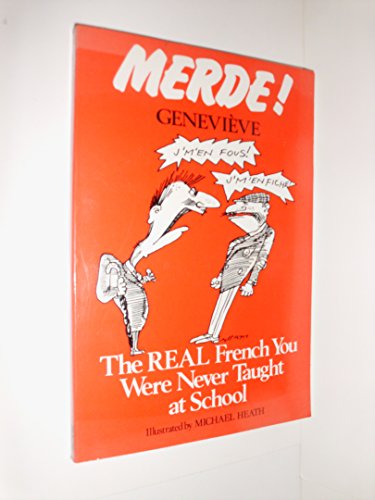
1995, trade paperback reprint edition (of a work first published in 1986), later printing, Fireside Books / Simon & Schuster, NY. 102 pages. Humorous illustrations by Michael Heath. When we had our high school French classes, we learned "proper French." And, of course, we wanted the real stuff, the dirty words, the street slang, the wild phrases that had nothing to do with "proper." Finally, we have it here, with a focus on: the body / love / sex / food and drink / money matters / and a few things none of us ever talk about (except in private, of course). Not for the faint of heart.
Preface Do you remember when you were learning French at school and looked in vain through your dictionary for all the dirty words? Have you thought you had a reasonable command of the language, then seen a French film or gone to France only to find that you could barely understand a word? You were, of course, never taught real French by your boring teachers, who failed to give you the necessary tools of communication while stuffing the subjunctive imperfect down your throat. French argot (slang) is not just the dirty words (though, have no fear, you will find them here); it is an immensely rich language with its own words for very ordinary things, words that are in constant use. Here, then, is not an exhaustive or scholarly dictionary of argot (that would be ten times thicker) but a guide to survival in understanding everyday French as it is really spoken.
Guidance
Asterisks after argot words indicate a degree of rudeness above the ordinary colloquial. Two asterisks show a whopper, although you should not assume that strength and rudeness cause a word to be used less frequently; au contraire.
When an English definition is underlined, that definition gives a good equivalent flavor, feeling and degree of rudeness of the French word. Good equivalents are not that common, so rely generally on the English definition for the meaning of the French word, on the asterisks for its strength and on the many examples for its usage. Just remember, to be authentic is to be rude.
Copyright © 1984 by Geneviève Edis