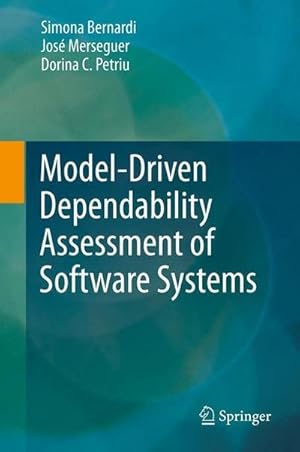
Model-Driven Dependability Assessment of Software Systems
Simona Bernardi
Sold by AHA-BUCH GmbH, Einbeck, Germany
AbeBooks Seller since August 14, 2006
New - Hardcover
Condition: New
Ships from Germany to U.S.A.
Quantity: 1 available
Add to basketSold by AHA-BUCH GmbH, Einbeck, Germany
AbeBooks Seller since August 14, 2006
Condition: New
Quantity: 1 available
Add to basketDruck auf Anfrage Neuware - Printed after ordering - Over the last two decades, a major challenge for researchers working on modeling and evaluation of computer-based systems has been the assessment of system Non Functional Properties (NFP) such as performance, scalability, dependability and security.In this book, the authors present cutting-edge model-driven techniques for modeling and analysis of software dependability. Most of them are based on the use of UML as software specification language. From the software system specification point of view, such techniques exploit the standard extension mechanisms of UML (i.e., UML profiling). UML profiles enable software engineers to add non-functional properties to the software model, in addition to the functional ones. The authors detail the state of the art on UML profile proposals for dependability specification and rigorously describe the trade-off they accomplish. The focus is mainly on RAMS (reliability, availability, maintainability and safety) properties. Among the existing profiles, they emphasize the DAM (Dependability Analysis and Modeling) profile, which attempts to unify, under a common umbrella, the previous UML profiles from literature, providing capabilities for dependability specification and analysis. In addition, they describe two prominent model-to-model transformation techniques, which support the generation of the analysis model and allow for further assessment of different RAMS properties. Case studies from different domains are also presented, in order to provide practitioners with examples of how to apply the aforementioned techniques.Researchers and students will learn basic dependability concepts and how to model them using UML and its extensions. They will also gain insights into dependability analysis techniques through the use of appropriate modeling formalisms as well as of model-to-model transformation techniques for deriving dependability analysis models from UML specifications. Moreover, software practitioners willfind a unified framework for the specification of dependability requirements and properties of UML, and will benefit from the detailed case studies.
Seller Inventory # 9783642395116
Over the last two decades, a major challenge for researchers working on modeling and evaluation of computer-based systems has been the assessment of system Non Functional Properties (NFP) such as performance, scalability, dependability and security.
In this book, the authors present cutting-edge model-driven techniques for modeling and analysis of software dependability. Most of them are based on the use of UML as software specification language. From the software system specification point of view, such techniques exploit the standard extension mechanisms of UML (i.e., UML profiling). UML profiles enable software engineers to add non-functional properties to the software model, in addition to the functional ones. The authors detail the state of the art on UML profile proposals for dependability specification and rigorously describe the trade-off they accomplish. The focus is mainly on RAMS (reliability, availability, maintainability and safety) properties. Among the existing profiles, they emphasize the DAM (Dependability Analysis and Modeling) profile, which attempts to unify, under a common umbrella, the previous UML profiles from literature, providing capabilities for dependability specification and analysis. In addition, they describe two prominent model-to-model transformation techniques, which support the generation of the analysis model and allow for further assessment of different RAMS properties. Case studies from different domains are also presented, in order to provide practitioners with examples of how to apply the aforementioned techniques.
Researchers and students will learn basic dependability concepts and how to model them using UML and its extensions. They will also gain insights into dependability analysis techniques through the use of appropriate modeling formalisms as well as of model-to-model transformation techniques for deriving dependability analysis models from UML specifications. Moreover, software practitioners willfind a unified framework for the specification of dependability requirements and properties of UML, and will benefit from the detailed case studies.
Simona Bernardi is a professor at the University Center of Defence, General Military Academy of Zaragoza, Spain. She has participated in several projects dealing with the development of fault-tolerant distributed embedded systems. Her research interests include software performance and dependability engineering, UML and object-oriented software development methodologies, and formal methods for the modeling and analysis of software systems.
José Merseguer is a professor at the Department of Computer Science and Systems Engineering, University of Zaragoza, where he teaches software engineering courses at graduate and undergraduate levels. His main research interests include performance and dependability analysis of software systems, UML semantics, self-adaptive systems and service-oriented software engineering.
Dorina C. Petriu is a professor at the Department of Systems and Computer Engineering at Carleton University, Ottawa, ON, Canada. Her main research interests are in the areas of software performance modeling and model-driven development, with an emphasis on integrating performance and dependability engineering into the software development process. She was a contributor to two OMG standards, the “UML Profile for Schedulability, Performance and Time (SPT)” and the “UML Profile for Modeling and Analysis of Real Time Systems (MARTE)”.
"About this title" may belong to another edition of this title.
General Terms and Conditions and Customer Information / Privacy Policy
I. General Terms and Conditions
§ 1 Basic provisions
(1) The following terms and conditions apply to all contracts that you conclude with us as a provider (AHA-BUCH GmbH) via the Internet platforms AbeBooks and/or ZVAB. Unless otherwise agreed, the inclusion of any of your own terms and conditions used by you will be objected to
(2) A consumer within the meaning of the following regulations is any natural person who concludes...
We ship your order after we received them
for articles on hand latest 24 hours,
for articles with overnight supply latest 48 hours.
In case we need to order an article from our supplier our dispatch time depends on the reception date of the articles, but the articles will be shipped on the same day.
Our goal is to send the ordered articles in the fastest, but also most efficient and secure way to our customers.
| Order quantity | 30 to 40 business days | 7 to 14 business days |
|---|---|---|
| First item | US$ 74.07 | US$ 85.94 |
Delivery times are set by sellers and vary by carrier and location. Orders passing through Customs may face delays and buyers are responsible for any associated duties or fees. Sellers may contact you regarding additional charges to cover any increased costs to ship your items.