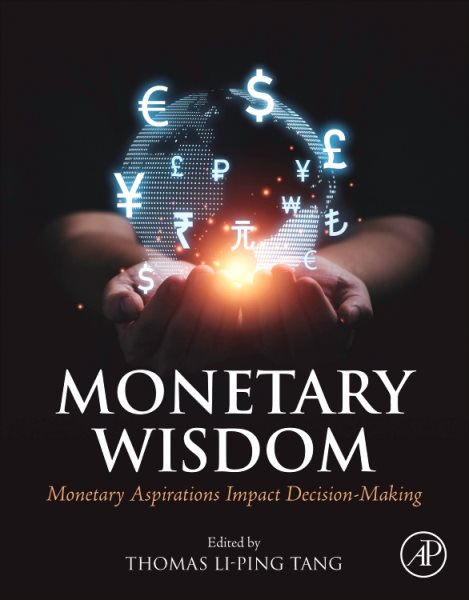
Globalization creates economic prosperity for citizens around the world. It changes people’s deep-rooted attitudes, values, and behavioral patterns. Editor Thomas Li-Ping Tang is the first to scientifically capture the meaning of money and coin the contemporary love of money construct. Ardent monetary aspirations involve affective, behavioral, and cognitive subconstructs. Monetary Wisdom: Monetary Aspirations Impact Decision-Making bridges the gaps between behavioral economics, business ethics, decision-making, and the psychology of money. It compiles research from world-renowned experts in 37 countries across 6 continents. This book presents an excellent collection of innovative and multicultural views. Monetary Wisdom investigates how individuals apply monetary aspirations as a lens, frame critical concerns at the proximal and omnibus contexts, and maximize expected utility and ultimate serenity at the individual, organizational, and global levels. The books’ practical implications help readers apply and enjoy these discoveries’ benefits.
- Inspires readers to learn one of the world’s most often used money attitude measures
- Notices that, in modern societies, money is power at the individual level
- Suggests that monetary aspirations (not money itself) predict cheating
- Profiles that reducing stress curbs dishonesty directly and indirectly
- Illustrates that leaders promote employees’ honesty and creativity
- Reveals how corruption expands prospect theory to a global level
- Explores the contexts to achieve balanced aspirations and serenity
Thomas Li-Ping Tang (Ph.D., Case Western Reserve University) is currently Professor Emeritus of Management, at the Jennings A. Jones College of Business, Middle Tennessee State University (MTSU). He has presented 263 papers in 27 countries and published more than 220 articles/chapters in 6 languages, including 33 on the Financial Times’ Top 50 Journals list. Researchers have substantiated his monetary wisdom in more than 50 countries across six continents and cited him in Bloomberg, CNN, and Financial Times. Köseoglu, Yildiz, and Ciftci (2018) ranked him the 8th in the world for his contributions to business ethics (1960-2015). He has served on the editorial board of 15 journals and as an associate editor for 2. As a recipient of the Career Achievement Award (MTSU) and the Best Reviewer Awards (Emerald and the Academy of Management), he is a Fellow of the International Association of Applied Psychology.