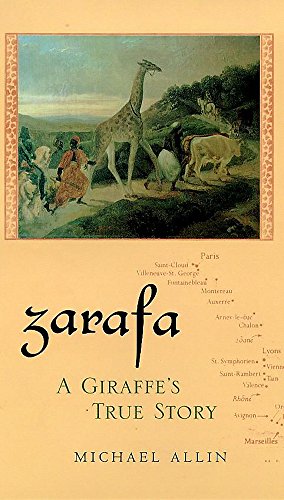
She was an intriguing royal gift and one that certainly caused a stir among the people of nineteenth-century France. On Tuesday 31 October 1826, a young Masai giraffe - Zarafa - landed incognito outside the bustling port of Marseilles.
Zarafa was the first living giraffe Europe had seen in almost 350 years and the first of her kind ever to arrive in France. She was a politically motivated tribute to Charles X from Muhammad Ali, the Ottoman Viceroy of Egypt, who had hope to forestall European intervention in his war against the Greeks. The gentle animal, however, soon became an adored celebrity in her own right and the embodiment of an era in French history rich in new scientific and cultural ideas.
Captured and tamed in the Ethiopian highlands, Zarafa travelled 3,500 miles down the Blue Nile and the Nile and then across the Mediterranean. After wintering in Marseilles, she was carefully and lovingly walked the 550 miles to Paris by one of the premier savants of the time, Etienne Geoffroy Saint-Hilaire. Along the way through villages and vineyards and from cottages and chateaux, the entire population was captivated by the 'beautiful African'. In Lyons, a crowd of 30,000 people turned out to see her. In Paris, the king, enthralled by his long-awaited curiosité, put Zarafa on daily exhibition in le Jardin du Roi. She became the rage of the city, providing a subject for songs, poems and political satires and the inspiration for fashion à la Girafe as women coiffured their hair so high that they had to sit on the floors of their carriages, men sported chic elongated hats and ties, and the children playing in the parks ate gingerbread giraffes.
Michael Allin's book is not only the enchanting story of the giraffe's epic journey. It is also a tale imbued with history. Linking primitive Africa with post-Napoleonic France, Zarafa was a symbol of an age fascinated by progress and the unfamiliar, an amazing creature that captured the hearts and imagination of men and women throughout Europe.
Bibliographical note: The strap-line used on the cover, 'The true story of a giraffe's journey from the plains of Africa to the heart of post-Napoleionic France', does not appear on the title page, which is simply 'Zarafa'. And that is how it has been catalogued here.
Zarafa was a gentle 19th-century giraffe, a simple animal whose life was dictated by the tumultuous times around her. From the African savanna where she was caught and tamed as an infant, Zarafa was shipped down the Nile--along with the meat of her mother and several hundred human slaves--to the shores of the Mediterranean Sea. From there she sailed on to France, a gift from Muhammad Ali, the "Renaissance Barbarian" viceroy of Egypt, intended to distract King Charles X while Egyptian forces invaded Greece. As political ploy, it didn't work. But as ambassador from an exotic land, this odd animal captivated the French people for almost two decades, as she lived out her life as part of the royal menagerie.
Michael Allin intertwines natural history with a brutal chapter in the history of civilization, augmenting the clarity of both. This story of one docile animal contrasts sharply with those of the human profiteers, warmongers, and interlopers who ultimately decide her fate. But Zarafa's otherworldly charm also helps us to understand the intrigue that led Napoleon to bring not only his troops, but a small army of European intellectuals to study all aspects of Egyptian culture and history, in the invasion that sets up her story. --Lauran Cole Warner