Synopsis
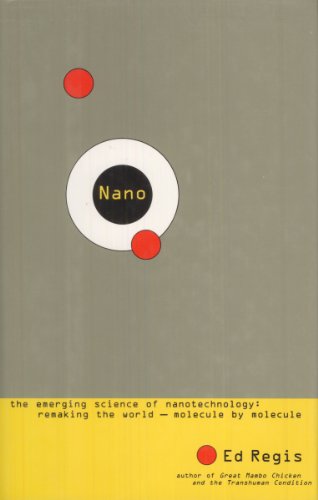
It's the ultimate technology: nanotechnology--the attempt to build ordinary objects from the atoms up, molecule by molecule. So named because its building blocks are the smallest pieces of matter, nanotechnology will give us complete control over the structure of matter, allowing us to build any substance or structure permitted by the Laws of Nature. Placing atoms as if they were bricks, nano-machines could turn grass clippings into prime sirloin--directly, without cows. They could turn coal into diamond, & sheets of diamond into rocket engines. Suitably reprogrammed, the tiny machines could repair all of your body's ailing cells. Science fiction? Actually, scientists have already isolated individual atoms and moved them at will, even using them to spell out words on a scale so small that the entire ENCYCLOPEDIA BRITANNICA can be written on the head of a pin. Conceived by Nobel Prize winning physicist Richard Feynmen & pioneered by the remarkable K. Eric Drexler, who earned the first Ph.D. in the field he created at MIT more than a decade ago, nanotechnology is astoundingly near. In NANO, acclaimed science writer Ed Regis introduces us to the visionary engineers & scientists--as well as the critics--of this imminent technological revolution & shows how their work may soon begin changing the world as we know it, with fleets of molecular assemblers churning out essential commodities without human labor, the world economy would be transformed, famine & poverty banished forever. With cell-repair devices coursing through the human body, aging could be postponed, even halted, common diseases eradicated permanently. But would this new world be a return to Eden or a rash step into a dangerous future? Programmed differently, those same molecular machines could become agents more potent than the deadliest viruses. Articulate, intelligent, & entertaining, Regis reports on the wonders and perils of this new technology, & traces its philosophical implications.
Reviews
Still in its infancy, nanotechnology, or molecular engineering, has as its goal the manipulation of atoms and molecules to manufacture virtually anything. Nanotechnologists aspire to create "designer proteins" that will assemble themselves into atomic-scale, self-replicating machines; and, in fact, Nobel Prize-winning physicist Richard Feynman predicted atomic-scale machinery as early as 1959. Billions of these "molecular robots" will replace human labor, restructuring matter to make houses, sailboats and cars, say nanotechnologists. With such control of nature, they predict, these proteins will one day eradicate diseases and greatly extend the human lifespan. While critics dismiss such proposals as quixotic, science writer Regis (Who Got Einstein's Office?) seems more optimistic in this engaging report on what may be tomorrow's alchemy. He describes the rudimentary feats, blueprints and aspirations of molecular engineers, notably MIT aerospace scientist K. Eric Drexler, the field's pioneer. Photos.
Copyright 1995 Reed Business Information, Inc.
If K. Eric Drexler's best guess is correct, in just 15 years--and that's a conservative estimate--cures for cancer, famine, and even human aging will all be within easy reach, courtesy of the marvels of nanotechnology. For the uninitiated, nanotechnology refers to science's rapidly developing ability to manipulate matter on a molecular scale and engineer microscopic machines capable of repairing or building virtually anything, atom by atom. Drexler, perhaps nanotechnology's foremost expert and most zealous proponent, gets star treatment from Regis, whose Great Mambo Chicken and the Transhuman Condition (1990) briefly touched on nanotech's wondrous, science-fiction-like possibilities. Regis follows the progress of Drexler's brainstorm, from its inception during Drexler's undergraduate days at MIT to its more recent and seriously considered endorsement before scientific subcommittees in Washington. Regis' lucid, clearheaded prose puts credible scientific foundations under nanotech's breathtaking potential and also underscores its horrifying dangers (imagine, for instance, a platoon of self-replicating nanowarriors running loose and consuming the environment). A fascinating preview of how an emerging technology may literally change the world. Carl Hays
Nobel laureate physicist Richard Feynman was the first to espouse the theory of molecular technology in 1959. It was 20 years later that much interest was shown, when K. Eric Drexler, an MIT graduate student, became fascinated with the idea of manipulating atoms and molecules to form tiny machines, which in turn could manufacture products to eliminate hunger, sickness, and poverty. When he published his ideas in the September 1981 Proceedings of the National Academy of Sciences of the United States of America, he became the leading proponent and guru of "nanotechnology" (a word he coined to describe this process). Not much was written about this absorbing subject until about ten years ago, but since then the literature has mushroomed, including Drexler's own Unbounding the Future: The Nanotechnology Revolution (LJ 10/15/91). Science writer Regis (Great Mambo Chicken and the Transhuman Condition, LJ 8/90) traces the short history of nanotechnology intertwined with an account of the life and times of Drexler. Recommended for all science collections, academic and public.?Eugenia C. Adams, Univ. of Houston-Downtown Lib.
Copyright 1995 Reed Business Information, Inc.
"About this title" may belong to another edition of this title.