Synopsis
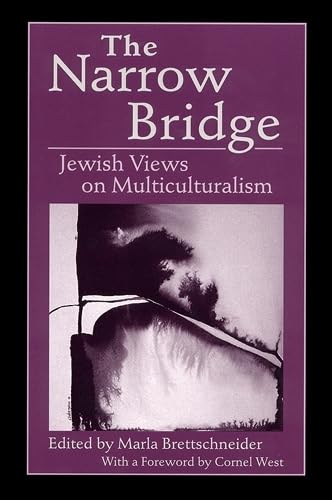
Multiculturalism in the United States has been tricky for Jews. Remaining outside of the dominant Christian culture yet often excluded from multicultural agendas, Jews walk a precarious line––a narrow bridge––between dominance and marginality. Many Jews, aware of the shaky identity of Jewishness, are deeply involved in all levels of the multiculturalism debate. But there still exists a need for careful, reflective analysis of the importance and dangers of multiculturalism to the Jewish community. What is multiculturalism? What can it be to the Jews? What can the Jewish community learn from and contribute to the current debate?
Through a collection of essays by scholars and activists whose writing ranges from the personal to the philosophical, The Narrow Bridge examines multiculturalism within and beyond the Jewish community. How does classism work within the Jewish community? How can synagogues reach out to gays and lesbians? How have tensions between Jews and Blacks developed historically and what can we learn from that history? How can we include Jewish studies in multicultural curricula? This timely collection of provocative articles makes fine use of these and other questions, offering us a look at where Jews have stood, where they now stand, and what they can hope for in the complex arena of multiculturalism.
From Kirkus Reviews
Brettschneider (Political Theory/Bloomsburg Univ.) brings together 20 articulate voices to walk the narrow bridge over the troubled waters of multiculturalism. The foreword by Cornel West, of Harvard, anticipates the many contributors who discuss the ``unique Jewish cultural amalgam'' in America ``that has yielded both relative material prosperity and existential anxiety.'' Ironically, it is the collection's only gentile contributor who raises the question of Jewish intermarriage and assimilation, the very ``melting pot'' that multiculturalism rejects (``Are the state of Israel and palpable anti-Semitism,'' West asks, ``the only solid pillars for Jewish identity and continuity in light of a Jewish exogenous marriage rate of over 50 percent in America?''). Moreover, three quarters of the contributors seem to display stronger multicultural credentials as leaders of feminist and lesbian organizations than as proponents of Jewish ``difference.'' Nonetheless, the professors of various disciplines gathered here, like sociologist Nora Gold, seem to have started out sharing the hope that multiculturalism would, in her words, ``provide a social climate where Jewish uniqueness would be legitimized along with the uniqueness of other social groups.'' Most are disappointed that multiculturalism has not only failed to welcome Jews, but may have contributed to a rise, rather than a decline, in anti-Semitism. Brettschneider says, ``Historic anti- Semitic fantasies have resurfaced at times--now from marginalized, rather than powerful, groups--about how Jews run the world and are to blame for the world's problems . . . despite our minority status and experience, often we are marginalized in multicultural circles.'' Many of the contributors seem to have subsequently turned inward, to work toward increasing the Jewish community's acceptance of women, homosexuals, and Jews of color. America is throwing a loud, colorful, multicultural party, and these academics (painfully successful, white, and secular) wonder why they weren't invited. -- Copyright ©1996, Kirkus Associates, LP. All rights reserved.
"About this title" may belong to another edition of this title.