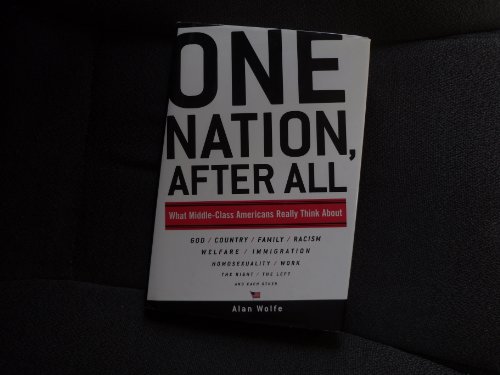
Synopsis
A survey divulges surprising information regarding the supposed division between The Left--pro-welfare, pro-abortion, etc.--and The Right--pro-family, anti-abortion, etc.--proving that many Americans share the same opinions and values, in an insightful look at middle class society. 20,000 first printing.
Reviews
Sociologist (Boston Univ.) and social critic par excellence, Wolfe (Marginalized in the Middle, not reviewed, etc.) scores again with this thorough, edifying, and engrossing study of the fabled but elusive American middle class. Based on his Middle Class Morality Project, a group of 200 interviews conducted by Wolfe himself in eight middle-class suburbs of four citiesAtlanta (DeKalb and Cobb counties), Boston (Brookline and Medford), San Diego (Eastlake and Rancho Bernardo), and Tulsa (Broken Arrow and Sand Springs)this intimate study is a smooth read. Wolfe is master of his material, and his easy, levelheaded style keeps you reading to the end, even if only to hear the ``silent majority's'' thoughtful answers to his pointed questions about religion (``quiet faith'' is the rule), welfare (good in principle, but poorly executed), racism (``Whites are against affirmative action, blacks tend to be for it, and Hispanics are split down the middle''), patriotism (robust, but skeptical), and family (``let people make those decisions that best fit themselves''). Wolfe's bottom line is that ``there are strong divisions in middle-class America . . . people in Brookline clearly do not think the same way as people in Tulsa.'' He grants, therefore, that America is experiencing a culture war, but ``one that is being fought primarily by intellectuals, not by most Americans themselves.'' Americans are far less polarized politically than pundits would have us believe, and lean instead, toward a ``sensible center,'' where compromise and tolerance guide public life. Americans share a strong libertarian streak, or as Wolfe couches it, ``respect for moral freedom and nonjudgmentalism cut so deep'' among middle-class Americans that they are willing to accept even the things they disapprove of most strongly (e.g., homosexuality, one of the most widely reviled). Wolfe's round-up is an absolute must for anyone who wants or, in every politician's case, needs to know how Americans think. (Author tour) -- Copyright ©1998, Kirkus Associates, LP. All rights reserved.
For what sociologist Wolfe calls the Middle Class Morality Project, he and an assistant interviewed 200 persons in 8 U.S. suburbs. The sample was too small for the findings to be nationally accurate, but was demographically balanced enough for them to be persuasively indicative of the entire American middle class. It was also small enough to accommodate long responses to questions about the right and wrong of the issues of the day. Wolfe discovered "over and over again, . . . ways in which polls do not get opinion in the country quite right." For instance, a large majority of the 200 felt homosexuality is immoral, but a majority also supported equal civil rights for gays. A great many objected to affirmative action, but staunchly advocated helping disadvantaged persons on the path to middle-class status. They thought of women working not in terms of rights but in terms of self-discovery. Their religious faith, though sometimes vehemently affirmed, was quite lacking in zealotry. And so on. Notably tolerant and disinclined to fight the culture war that partisan commentators say is raging in America, they upheld what Wolfe characterizes as "morality writ small," which is largely a matter of personal responsibility for obligations close to home. A committed liberal, Wolfe regrets such modest morality. Many others may welcome it, even with tears of relief. Americans aren't so awful, after all. Ray Olson
The nation is divided between the pro-welfare, pro-choice Left and the pro-family, anti-Left Right, right? Wrong, says sociologist Wolfe, who argues that Americans agree on most issues.
Copyright 1997 Reed Business Information, Inc.
"About this title" may belong to another edition of this title.