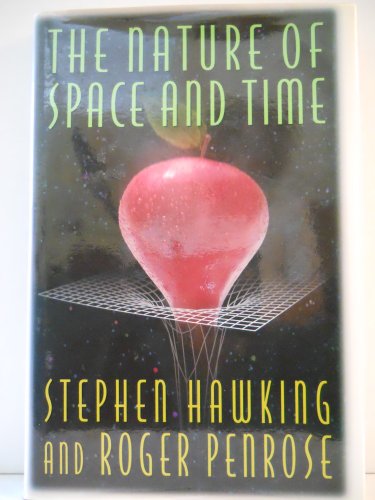
The Nature of Space and Time
Stephen W. Hawking; Roger Penrose
Sold by ThriftBooks-Atlanta, AUSTELL, GA, U.S.A.
AbeBooks Seller since March 24, 2009
Used - Hardcover
Condition: Used - Very good
Ships within U.S.A.
Quantity: 1 available
Add to basketSold by ThriftBooks-Atlanta, AUSTELL, GA, U.S.A.
AbeBooks Seller since March 24, 2009
Condition: Used - Very good
Quantity: 1 available
Add to basketMissing dust jacket; May have limited writing in cover pages. Pages are unmarked. ~ ThriftBooks: Read More, Spend Less.
Seller Inventory # G0691037914I4N01
From two of the world's great physicists―Stephen Hawking and Nobel laureate Roger Penrose―a lively debate about the nature of space and time
Einstein said that the most incomprehensible thing about the universe is that it is comprehensible. But was he right? Can the quantum theory of fields and Einstein's general theory of relativity, the two most accurate and successful theories in all of physics, be united in a single quantum theory of gravity? Can quantum and cosmos ever be combined? On this issue, two of the world's most famous physicists―Stephen Hawking (A Brief History of Time) and Roger Penrose (The Emperor's New Mind and Shadows of the Mind)―disagree. Here they explain their positions in a work based on six lectures with a final debate, all originally presented at the Isaac Newton Institute for Mathematical Sciences at the University of Cambridge.
How could quantum gravity, a theory that could explain the earlier moments of the big bang and the physics of the enigmatic objects known as black holes, be constructed? Why does our patch of the universe look just as Einstein predicted, with no hint of quantum effects in sight? What strange quantum processes can cause black holes to evaporate, and what happens to all the information that they swallow? Why does time go forward, not backward?
In this book, the two opponents touch on all these questions. Penrose, like Einstein, refuses to believe that quantum mechanics is a final theory. Hawking thinks otherwise, and argues that general relativity simply cannot account for how the universe began. Only a quantum theory of gravity, coupled with the no-boundary hypothesis, can ever hope to explain adequately what little we can observe about our universe. Penrose, playing the realist to Hawking's positivist, thinks that the universe is unbounded and will expand forever. The universe can be understood, he argues, in terms of the geometry of light cones, the compression and distortion of spacetime, and by the use of twistor theory. With the final debate, the reader will come to realize how much Hawking and Penrose diverge in their opinions of the ultimate quest to combine quantum mechanics and relativity, and how differently they have tried to comprehend the incomprehensible.
"About this title" may belong to another edition of this title.
We guarantee the condition of every book as it's described
on the Abebooks website. If you're dissatisfied with your
purchase (Incorrect Book/Not as Described/Damaged) or if the
order hasn't arrived, you're eligible for a refund within 30
days of the estimated delivery date. If you've changed your
mind about a book that you've ordered, please use the "Ask
bookseller a question link to contact us" and we'll respond
as soon as possible.
All domestic Standard shipments are distributed from our warehouses by OSM, then handed off to the USPS for final delivery.
2-Day Shipping is delivered by FedEx, which does not deliver to PO boxes.
International shipments are tendered to the local postal service in the destination country for final delivery – We do not use courier services for international deliveries.
| Order quantity | 4 to 8 business days | 4 to 8 business days |
|---|---|---|
| First item | US$ 0.00 | US$ 0.00 |
Delivery times are set by sellers and vary by carrier and location. Orders passing through Customs may face delays and buyers are responsible for any associated duties or fees. Sellers may contact you regarding additional charges to cover any increased costs to ship your items.