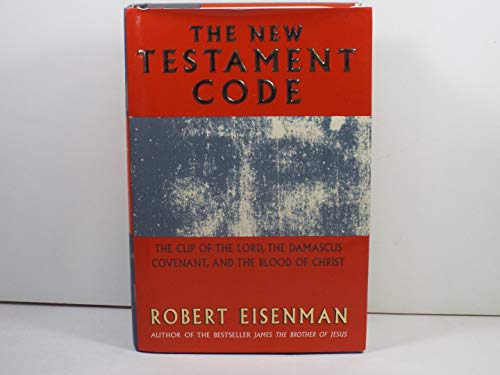
It’s finally here?and Eisenman’s many readers will not be disappointed! In this follow-up to his blockbuster biblical studies, world-renowned scholar Eisenman not only gives us a full examination of James’ relationship to the Dead Sea Scrolls, he also reveals the true history of Palestine in the first century and the real ?Jesus’ of that time. It’s a work of intriguing speculative history, complete with a conspiracy theory as compelling as any thriller.
Eisenman begins with a question: ?Is there a ?New Testament Code?’” He proves that there is?and exposes the deliberate revisions, falsifications, and historical trivializations introduced into New Testament writings. In so doing, he identifies the Scrolls as the literature of the Messianic Movement in Palestine and ?decodes” many favorite sayings in the Gospels, including ?These are the signs that the Lord did in Cana of Galilee.” Offering a point-by-point analysis of James’ relationship to the Dead Sea Scrolls, he illuminates such subjects as the ?Pella Flight,” the wilderness camps, and Paul as an ?Herodian,” and demonstrates how, once we have found the Historical James, we will find the Historical Jesus.
Every page presents fascinating new insights and revelations that will leave Eisenman’s many fans enraptured. And because it will coincide with the release of the similarly themed film of The Da Vinci Code, interest will be high.
Eisenman, a Dead Sea Scrolls scholar and an expert in first-century Christianity, theorized in his book James the Brother of Jesus (1997) that the Qumran community, assumed to be responsible for the original Dead Sea writings, was important in the development of early Christianity. He further advances that theory here, once again using literary analysis of pertinent texts. Eisenman examines such topics as James' relationship to the Qumran community's Teacher of Righteousness and offers a reinterpretation of the Dead Sea Scrolls, especially the relatively recent translation of the MMT document, which he links to a Jamesian proto-Christianity. There is also much here about the Messianic movement in the first century and, more personally, about Peter and Paul's relationship to James and to one another. As in the previous book, however, Eisenman's writing is dense and often difficult to follow without a solid knowledge of the subject. Readers wishing to delve more closely into his sources will have to check the notes online. Moreover, he also uses some of the hefty work's 1,120 pages to settle some internecine scholarly feuds. As always, Eisenman's ideas are provocative, but it will take dedicated readers to digest them. Ilene Cooper
Copyright © American Library Association. All rights reserved