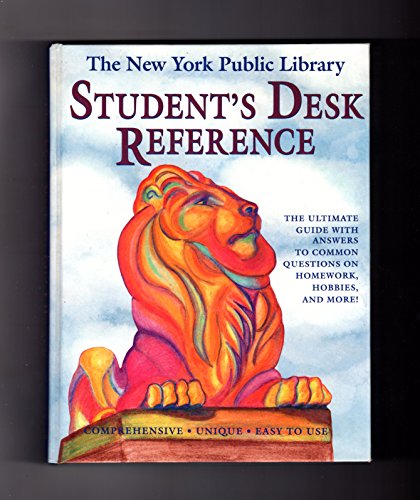
Based on questions that students frequently ask reference librarians, this comprehensive guide covers such topics as religions, the universe, computers, etiquette, health and fitness, fine arts, and others.
Designed to "satisfy the natural curiosity" of the nine- to fourteen-year-old crowd, this book is in 24 sections, including those on the universe; the animal world; weights and measurement; mathematics; computers; inventions and scientific discoveries; fine arts; libraries and museums; religion; the legal system; sports, games, and fun; and health and fitness. Each section ends with "Information, Please," suggestions for further reading, most of which are from the late 1980s to the early 1990s. Boxed features add interest throughout the volume: a list of Newbery Medal books, how jurors are chosen, hockey record holders, etc. The color maps in the atlas section are current vis-a-vis the changes wrought by the unification of Germany and the breakup of the USSR, Czechoslovakia, and Yugoslavia. Unfortunately, the maps are placed in the middle of the book in the literature section instead of between the U.S. and world sections. It's always fun to argue over which writers should make "most important" lists. In the literature section, the lists seem to include a balanced representation, but will a child aged 9-14 really be interested in Mordecai Richler, Thomas Pynchon, or Mary McCarthy?
While duplication with the "adult" version, The New York Public Library Desk Reference, occurs (e.g., signs and symbols, anatomy diagrams), this source contains new information as well (e.g., etiquette for the intended age group). The astonomy section even includes the changing orbits of Neptune and Pluto. The larger print and page layout are age appropriate.
This source will be useful in school libraries and in public libraries where the adult version is heavily used. Young patrons may also enjoy a copy to check out for more extensive browsing.